Showing posts with label Europe. Show all posts

Tuesday, February 23, 2016

Fear in the corridors of banks...

When did European banks start showing signs of a fatigue. Was it today, yesterday or the day before?
A few weeks ago, it was Deutsche Bank.
Yesterday it was HSBC.
Today it is Stanchart.  Standard Chartered Plc reported a loss of $981 million from its India operations. Loan impairments, including restructured loans, in India portfolio went up to $1.3 billion in 2015. It has also suffered on account of commodity price falls. Stanchart has run in to a loss of $1.5bn for 2015. Stanchart is an emerging market entrenched bank and reflects the agonies of the situation for financial institutions in these markets.

It seems that European big banks may have lost reflexes.  This fall in shareholder values  is not a sudden development ; it has been a developing story for quite a few years. Valueless banking (LIBOR fixing, money laundering involvement, breaching sanctions) all indicate a fall in value systems among bank managers in Europe.  It is not specific to a bank but across the industry.

It cannot be that economies do not do well and banks do. Banks are financial institutions that lubricate the real sector. They are at the heart  Example: Emerging markets are running out of steam with heavy stones of NPAs and slowing economies round their neck. example, the QE that was attempted by the ECB a few months ago,  is an aftermath of a stalled real sector. The latter state of affairs  had to affect the financial sector at least with some lag. Monetary pump priming also makes it easier to distribute credit but it also facilitates adverse selection. Banks dump credit on to customers who find it difficult to survive a difficult economic situation in the real world. Banks and other financial institutions cannot make profits even as the real sector is in a state of sluggishness.

Markets must run more on fundamental factors and less on sentimental expectations.

This blog recommends no investment. All views expressed are without any risk or responsibility.


Sunday, February 21, 2016

Why the coming nervous week is not so reassuring:...

  • Non-performing loans of banks are high or under-estimated in China, India, and Europe.
  • Bank profitability will be consequentially affected.
  • Losses and provision requirements would make holes in bank capital.
  • Banks have to be further  capitalized as per regulatory norms.
  • To facilitate stronger balance sheets, capital induction has to ensue.
  • New investors will hold off in crashing equity markets and if Governments have to support as in the case of India, Government funding will hit Government's fiscal position; neutralizing moves towards fiscal  balancing.
  • Bank businesses will improve but quite slowly even as banks struggle to redraft (clean up) balance sheets. Business growth, consequentially, will be halting, gradual and slow. There will be significant impacting on business and there will be differential impacting with many small businesses affected. Uncertainties will accelerate the market turmoil.
  • The Chinese and Indian economic expansion represent how there is a debt overhang.   The strong asset price growth seems to wind up to a bubble. There has been apparent overinvestment in sectors like real estate. As growth decelerates, all these further credit excesses will expose banks anew and the business failures will accelerate the economies' downward moves. Leveraging will enhance risks. There will be adverse selection too as banks struggle to regain profitability.  
  • Political risks will accentuate in Turkey and the Middle East. Commodity prices affect Gulf Cooperation countries, Australia, South Africa, Indonesia and Russia. Brazil and other Latam countries too look vulnerable.  
  • Thus,  there is expectation of volatility global markets, in equities , foreign exchange and commodity prices. There should be widening in risk spreads as bank , corporate and emerging markets  are downgraded by rating agencies.   
 Volatility is the spice of a trader's losses.


This blog recommends no investment. All views expressed are without any risk or responsibility.


Wednesday, January 6, 2016

Winter in markets...

'Freezing in Fear' Factors:


  • Chinese growth slippage.
  • Slide in the yuan.
  • Japanese recessionary inclination, coupled with strengthening yen - which is seen as a safe haven. 
  • Australian commodity price falls.
  • North Korean atomic exploits.
  • China vs Vietnam.
  • Gulf affected by downhill oil prices.
  • Europe's economic problems seem to linger.
  • Political disunity in Europe. The burden on Germany and France owing to geopolitical tensions. 
  • Post 2011 chaos in the Middle East.
  • An imperious Russia seeking to reassert.
  • Saudi Arabia versus Iran. Sectarian divisions on religious lines. 
  • A slow moving India where internal dissensions hold up governance and reforms.
  • Volatility in the markets. (Cause and effect)
  • Stress in the financial sector.
  • Services industry slowdown owing to geopolitical moves. 
  • Appreciation of the dollar and a global slowdown might affect USA. 


The views expressed are without any risk or responsibility.


Tuesday, December 29, 2015

Deutsche Bank: 2016: To restoring a Brand ...

Achtung! The slippage in Brand Value of a 146 year old bank ...
  • 2015 was a year of retreat of the German bank's  brand.  The brand value clearly suffered:
  •  with  fines in billions imposed by banking regulators in several jurisdictions ;
  • there were allegations  that the bank had manipulated key market rates including Libor;
  • maneuvered  currency and government bond markets; that the bank had moved funds to  countries under sanctions;
  • the bank's employees had possibly indulged in  fraudulent collaboration;   
  • its officers may have “repeatedly misled” the regulators .  
A Passion to Re-perform - to rebuild   
  • So Deutsche Bank  changed its senior managers;
  • brought in John Cryan as co-Chief Executive Officer of Deutsche Bank for a new tryst with destiny.
  • Deutsche has adopted divestment as a turnaround strategy and went public with this strategy;
  • it withdrew from the two largest economies:  USA and China (Close on the heels of the retreat from USA investments where it sold to Raymond James of Florida, Deutsche is now reportedly selling its 20 percent share in Hua Xia Bank for $ 4 billion. to Property and Casualty Company ltd);
 It seems to be  attempting to rebuild brand through
  • Leveraging down the price pillar; price is a function of cost, so Deutsche has to have a revolving door for staff ring out old; ring in new. A more cost efficient resources utilization. 
  • Leveraging up Quality.  The Deutsche team must be trained and prepared to manifest professionalism and ethical conduct toward regulators and customers.
  •  Leverage up Support   Increase the level of capital support  
  • Leveraging down   Availability : Divesting out of areas to areas with potential opportunity beyond the existing market and exploit it. 

This blog recommends no investment. Views expressed are without any risk or responsibility. 

Wednesday, October 28, 2015

Why the Fed may not rise rates...

Volatility in financial markets are accentuated by expectations concerning U.S. interest rates ; this also affects  the value of the dollar,  and dents emerging market economies through hot money flows. The Fed may pretend to be concerned with this expectation driven volatility but at heart it is only concerned with what is good for USA.

The Fed has two objectives (i)  maximum employment and (ii) price stability. Both of these are just fine now for the USA. Fed may not want to disturb it.

The Fed maintains a highly accommodative monetary policy stance since the financial crisis and this has supported growth and jobs while holding deflation at bay.

Recent developments in the global economy, especially those originating in the Chinese economy, holds Fed back. China is as yet struggling to achieve a higher growth rate and to tide over its stock market failures

The Fed recognizes that China is important for the global economy and any hike now might affect it adversely Europe cannot be said to have settled with Draghi promising more quantitative easing if need be.  

So Fed will wait for clear signs of a warming economy- indications of more jobs and   be sure that inflation is moving towards to 2 percent over the medium term before it moves to raise rates.

Views expressed without any risk or responsibility. This blog recommends no investment. 

Thursday, October 8, 2015

Deutschland: Its more of Debit than Credit...

First came the ignominy of corporate manipulation by Volkswagen in its software. German management principles are as much under stress as the economic firmament.

Then comes the news that exports fell hard and long - by 5.2% in August compared to July, according to Germany's  Statistics Office.  The imports in to Germany too had fallen ; so trade inwards and outwards were both affected.  

Then came the losses for 3rd quarter at Deutsche Bank where losses exceeded $ 6. 7 billion . 

If Europe's  big economy is weakening. markets will capture the economic seismic tremors. 
It seems a seller's day. 

The views expressed are without risk and responsibility. This blog recommends no investment. 

Monday, October 5, 2015

New bull run?

With the US Fed restraining itself from a rate hike,  (or with mixed data holding its hands), global equity markets seem to be on an optimistic note.
The benefit of lower American interest rates may be be more now for Australia, Europe and North America. These may be parking slots for funds which have already left emerging economies. With QE from ECB, the European markets look set to grow. Asian giants China and Japan seem a little unsure of themselves  and so investors may prefer Europe to Asia.

With dollar sagging a shade , gold too looks good.  If gold glitters, commodities will tag along.

Trend is your friend and in the long run we are all dead , as Keynes reportedly said.

The views expressed here are without any risk or responsibility. This blog recommends no investment. 

Saturday, August 22, 2015

One cannot expect gold to rise even as oil falls!!!


  • Gold and oil are normally positively correlated.  More recent talk of divergence does not have historic backing. 
  • Commodities' markets  should move together.
  • If stock markets collapse, there is a wealth effect and there cannot be a flight to gold as is anticipated. 
  • If there are are losses in one market, there will be sales of other assets to recoup losses.
  • With deflation staring (in the event of bearish trends) gold loses attractiveness. 
  • It is a different story if US  interest rates are hiked and inflations looks likely to rear. 
  • The international scenario may hold the Fed's hands.
  • Political imbroglio in Greece adds to European woes.
  • If the Government of India cannot come out with a marketable plan for ensuring the transfer of gold holdings to banks (as is proposed) then there could be some stimulus for international gold.  The Indian banks seem  reluctant to offer more than 0.75 % interest to gold bonds. 
  • If the Indian growth rate falls, following China, that would imply less purchasing power. 
  • The Chinese stock market falls may have hit local Chinese hard given that 80 to 85 % of stock holders are nationals. 
  • Against such a scenario, any move up in gold prices does not necessarily reflect real moves but expectations.
  • If the Indian festive season picks up in October- November and if the Fed moves rates up, there could be a rebound of gold. Until then  any investor has to be cautious
This blog does not recommend any investment. This is only an academic blog without any risk or responsibility to the blog's author. 

Monday, July 13, 2015

Why I would sell the euro rather than buy it...

"Too many leaders do not translate to leadership. Many spoke. None inspired confidence . "

  • The European  leadership seems unable to understand the nature of the network of strategic issues facing the Union. They have too many leaders and a seemingly  unrealistic, coordinated strategy.The Germans seem to suggest that the Greeks have no distinctive or core competencies. They have virtually written off the Greek people as unable to exploit any competitive advantage. To be in the German  good books, Greece needs activities processes and skills that are rather difficult for competitors to imitate and therefore underpin competitive advantage.  That is  a difficult order in a country that has nearly 50 % of its youth unemployed.  European supervision will ensure harping on productive employment- which should aggravate rather than mitigate unemployment. ("Fiscal Consolidation"???)The terms of the Greek bailout are significantly tougher than pre- referendum a week ago. In addition to requirements on pensions and sales taxes,  creditor representatives now have full access to ministers and a veto over relevant legislation. So Greece now seems like a European colony. The Asset reconstruction Fund seems old wine in a new bottle. 


  • Morgan Stanley says it fears that China might just tip the globe into another recession. The desperation in Chinese regulatory action: the iron handed arrest of a fall in the overheated stock market supports the fears of instability potential. Chinese capital flight might have already occurred. It will not go to Europe but might go to the dollar assets or Australian / Canadian property markets.


  • Saudi Arabia is borrowing big time (First time since 2007).  It reportedly has a deficit of about $130bn this year. The  air war on Yemen is taking its toll.  Saudis may already have drawn down near just about 8 % of its forex reserves.  With Iran accord, almost there, oil will run through the streets of glut. 

Sell on the fact ; buy on the rumour. 


This blog is not intended as an Investment Advice. This academic work is without any risk or responsibility.

Sunday, July 12, 2015

IMF Official on Greece


Blachard says:

·         The 2010 program only served to raise debt and demanded excessive fiscal adjustment.
·         The financing given to Greece was used to repay foreign banks
·         Growth-killing structural reforms, together with fiscal austerity, have led to an economic depression

 A realistic solution had to involve some adjustment, some financing, and some debt
relief — a balanced approach. The role of the IMF in the negotiations was to ask for specific credible adjustments in policies, and make explicit the financing and debt relief implications.

A Path Forward 
  1. ... a more explicit recognition of the need for more financing and more debt relief.
  1. ... lower reforms and fiscal targets for Greece means a higher cost for the creditor countries. The role of the Fund in this context is not to recommend a particular decision, but to indicate the tradeoff between less fiscal adjustment and fewer structural reforms on the one hand, and the need for more financing and debt relief on the other.
  1. The room for agreement is extremely narrow, and time is of the essence. There should be no doubt that exit from the Euro would be extremely costly for Greece and its creditors. The introduction of a new currency, and of redenomination of contracts, raises extremely complex legal and technical issues, and is likely to be associated with a further large decline in output.  It may take a long time for the depreciation of the new currency to lead to a substantial turnaround.

Source
http://blog-imfdirect.imf.org/2015/07/09/greece-past-critiques-and-the-path-forward/


Without any risk or responsibility

Saturday, July 11, 2015

USA has a winning Strategy and no competitors....


"What is most important  is not what happens but what it means"...

Of late,  USA displays  rare political acumen; its foreign policy strategies are so sagacious and so quietly successful. It has tactically withdrawn from battle fronts in Asia. It has refused to be drawn back despite hidden and direct invitations. It has extended a hand of friendship to Cuba. It is mending fences with a broken Venezuela and its Lat Am neighbours.  It makes the right noises on Africa but does not overtly meddle any more. It lets Israel blast its policies in its Congress even as it delays signing a treaty with Iran. In Asia, while recognizing China as its  major trade partner, it is  laying out a network of potential allies  ranging from India to Japan in an attempt to contain Chinese growth ambitions. USA geo-political strategy manages contradictions so well. 

Much as the US   strategists might like (if not love) it, the middle east is split through  the centre in schism. The division between Saudi Arabia and Iran as respective leaders has vertically split the Middle East.  Heard disbeliefs are severe, unheard discontent elements are several. The post Feb -2011 events have disturbed the very fabric of the Arab society. Democracy  is seeking an agonizing birth.  The polity seems caught between 2 worlds, one refusing to die and the other not bold enough to be born.  Egypt is a classic example of dilapidated nations, fast sinking to be of the status of Jordan, a  dignified dependent on others. It is a self destructive path so often seen previously in Lebanon. As the USA withdraws tactfully in Afghanistan and Asia, there is a rush of power to fill in that vacuum. The power brokers will see destructive engagement.

Economically, Europe is split asunder between the haves and have-nots. Greece imbroglio  has shown off the lack of leadership skills in Germany, and the Germans are USA's economic major competitor at all times. Any peace brokered through the acceptance of Greek proposal would be ephemeral.  It would be a humiliated, restive and helpless Greece that accepts austerity. The mental perspective in an average Greek mind is that Greece has been pushed into a blind alley by Germany. That is not a perspective that would help the integration of / fusion of Europe.  The other peripheral countries have already indicated a resurgence of nationalism. Britain, which has more in cyclical patterns in common with USA and which sulks at Teutonic dominance, would wait to move away from a weakened Europe, with a tacit support from across Atlantic. Bid European Banks too seem to do negatively , thanks to its non adherence to norms of US regulators.

Any semblance of a victory for Germany would strengthen the euro and that should help USA exports.  ( "In particular, the higher foreign exchange value of the dollar that I mentioned, as well as weak growth in some foreign economies, has restrained the demand for U.S. exports." - Janet Yellen  at the City Club of Cleveland, Cleveland, Ohio, July 10, 2015 Recent Developments and the Outlook for the Economy")

Oil is in a situation of glut. So the inventory levels take USA  to a situation of  comfort zone. Even though it might speak  of falling investment in the petroleum sector, it has benefited the USA  customer and left him a wealth effect as real incomes go up. There will be consequential spending in USA which should buoy up the economy further. The wealth effect on the Gulf countries will reduce the accelerated growth of city states like Dubai. Football issues and labour issues have dogged the prosperous Qatar. USA just has to keep it all simmering. With Russians licking economic wounds, and economic bubble woes holding back China, USA  does not have to worry so much. It is far too ahead in the lead of economic strategy.

China, the Asian giant is in a state of limbo with its asset prices falling. The wealth effect of a $3 trillion loss incurring Chinese economy is stupendous. There is more to it than meets the eye in the Chinese policemen enquiring as to who all short sold. Chinese consumers will feel less prosperous after stock market wounds and refrain from buying. It will add to social disquiet too. Internationally, the image is  of a state intervening, fickle tock market in China. Chinese have also to encounter its unstructured capital market products which are patently over-leveraged.   

The Japanese are still recovering from the local  economic harakiri inducing inertia , nay stupor triggered by a recession older than decades. Neither monetary policy nor fiscal policy seems to revive confidence in a fatalistic society.

India , despite good leadership, is held back by a splintered polity. Reforms are delayed by a difficult opposition.  Thus the growth rate of 7.5 % looks great but the economy's moving further, like its infrastructure, is on slow and often pothole ridden roads.  If only its central bankers could talk less and concentrate on banking sector's  non performing and stressed assets, and only if there was more professionalism among its civil servants!

With commodity prices down, (from copper to coal to gold, it is a shortening scenario) and the tigers struggling, there is nowhere to turn to except the dollar assets. May be the Yen may hold some safe haven status being least problematic among competitors. The Swiss are on to negative interest!

Janet Yellen has  indicated that there is a fair  likelihood of a rate hike. The global markets have long factored this in. With the rate hike quarters pruned to probable last quarter, and with just data supported evidence of growth needed, there will be a bee line for US assets. The rest of the world will see a compensatory sell off as the institutional investors shift to USA. The cost burden of the rate hike will be factored in by US  corporations , which are among the most productive technologically.

USA has, it appears,  for its  strategy 'Carpe noctem': 'Seize the night'


Without any  risk or responsibility.


Sunday, July 5, 2015

A Long day for shorts... dollar is the king...

Congratulations , Greece.
Figures published by the Greek  interior ministry indicated 61% of those whose ballots had been counted voting "No", against 39% voting "Yes".

The statement of the Eurogroup President following the referendum was "I take note of the outcome of the Greek referendum. This result is very regrettable for the future of Greece. For recovery of the Greek economy, difficult measures and reforms are inevitable. We will now wait for the initiatives of the Greek authorities. The Eurogroup will discuss the state of play on Tuesday 7 July." Lack of reconciliation was writ large on a terse statement. 


The euro has quite a South road to traverse. As predicted here, Australian dollar started the rout. Commodity prices will fall. Oil and Gold should follow commodity prices south.Yen may hold on.  The dollar is the king. Chinese turmoil may accelerate falls. It is a long day for the short of it. 

Without any risk or responsibilty."

Greece either way, Europe is a loser

Greece voting is under way; either way the result has already weakened Europe. The current imbroglio  has set back the concept of a federal Europe.

It also indicates that Europe has been unsuccessful in throwing up a pan European leader. There are German and French and British and Greek leaders ; but no European leaders. The last European was perhaps Willy Brandt...With low cost economies in Asia, and with strong leaders like Modi  and Xi Jinping and Abe and Obama , Europe has none to match. Had there been a Charles De Gaulle today, may be... But seldom have European leaders risen above national interests. Nationalism is at the centre of the Greek referendum. Nationalism will resurge with the German domination sensed.

If China and India join in economic infrastructure building, that action  may set Europe's clock by several centuries. Centuries ago, Europe had the fire power and  mapping abilities. Then they could colonize. Now at most they can emigrate to Australia or Canada.

Innovation has virtually ceased to emerge out of Europe. Science, which was so prosperous in Europe, is caught up in this turmoil. British Universities, for example suffer research funding constraints.
Whatever little happens towards this direction of innovative thinking these days,  seems to emerge out of Nordic areas or Germany. The rest have become cost heavy.

Has Europe ceased to deliver value? Value is benefits minus costs. It has few benefits to give and has become too cost heavy. Companies may have to migrate to more successful locations. Just like jobless driven Greeks.


Without any risk or responsibility....

Wednesday, July 1, 2015

ECB's Structural data reveals fall in bank employment in Europe

  • Decline in number of bank branches continues in most EU countries
  • Number of bank employees down by about 74,000 to around 2.8 million
  • the number of branches of domestic credit institutions has continued to decline, from around 211,000 at the end of 2013 to some 204,000 branches at the end of 2014. The number of employees of credit institutions in the EU has also fallen, to around 2.8 million in 2014, a decrease of some 74,000 compared with the figure for 2013.

https://www.ecb.europa.eu/press/pr/date/2015/html/pr150701.en.html
Note Data released for 2014 on 1 July 2015

If Kurosawa were to redo the Greek script...

Tsipras' view 

  • Europe is unfair.
  • Europe and creditors are heartless.
  • The referendum is to restore national dignity versus austerity. 
  • Greek's long term and my party's short-term interests — political survival and national unity.
  • have to be protected.
  • Signing a deal with Europe risked Greece's  fragmentation and financial  collapse  
  • We oppose any deal imposing more austerity measures.
  • Creditors' proposals for pension cuts and tax hikes would ruin Greece,  


Jeroen Dijsselbloem,

  • I tried... any new rescue may require tougher conditions than those Greece has already rejected because of the rapid deterioration in the country's finances.
  • a comprehensive and detailed list of agreed reforms is needed .


Angela Merkel

  •  Athens is to blame for allowing the bailout program to expire.
  •  It is up to the Greeks to move in
  • Decisions on Greece could only be taken on a day-to-day basis given the current level of uncertainty...
  • There is possibly Athenian arrogance...
  • They unnecessarily blame Teutonic arrogance


George Osborne  , the chancellor  
UK prepares for the worst on Greece, ..It is uncertain times.

IMF
"if only we could and if only the Europeans knew."

USA
Greece must stay so that the euro will stop falling.

The Greek people
Caught between fear and the euro


.
 Without risk or responsibility

Friday, June 26, 2015

Tsipras: Managerial Retreat - Lessons from Greece

When a Leader  is pushed in to a corner and has nothing but the wall to turn to: 
a) He takes the battle to his people. He works on the principle of apparent transparency in decision making. However, it actually is that he is on a blind alley. then the leader recalls that 'My enemy's enemy is my friend. ' . 
b) He creates a scenario of distress and darkened future. Of denunciation of an old ally by richer erstwhile allies. 
b) Denounce the opponent in vehement terms :(Tsipras suggested 'blackmail' by lenders)
c) Declaims a higher responsibility: ("Our responsibility is for the future of our country.")
d) He evokes wrong deeds inflicted on his people and seeks retribution for it.( "humiliation of the entire Greek people".)

Tsipras seems to be using symbolic messaging to stir up his people to emotionally delinking from Europe. He is suggesting that they have nothing to lose but their austerity chains. He has turned it into a haves vs have-nots fight.


Without any risk or responsibility

Time to buy into Spain?

"In 2014, Spain's GDP grew at a rate of 1.4% while employment did so at 1.2%, the first positive figure since the start of the crisis.

The Spanish economy will grow at a rate of 3.1% on average in 2015, an upward revision of 0.3 pp on the projections published in March.

 Average growth in the first half of the year, in annualised terms, is thus expected to be around 4%.
 expansionary impulses, such as the fall in oil prices and the depreciation of the euro. For 2016, the projections estimate average growth of 2.7%.

The general government deficit met the objective set by the European Council (5.8% of GDP) for the third year running. In 2014, fiscal policy had a less restrictive impact than in the preceding years and was a less prominent conditioning factor of macroeconomic developments.

The public debt/GDP ratio rose in 2014 to 97.7%, 

Spanish household debt stood at end-2014 at 71% of GDP, 10 pp above the euro area average, when in 2010 ... (was) 20 pp above it; non-financial corporations' debt stood at the end of last year at 92% of GDP, 8 pp above the euro area average, when in 2010 the gap was 35 pp.

...non-performing loans (NPLs) to the resident private sector fell both in absolute terms (by more than €24 billion) and in terms of the NPL ratio, which declined by almost 1 pp to 12.9%."


(Excerpts from Testimony by Mr. Luis M Linde, Governor of the Bank of Spain, before the Parliamentary Committee on Economic Affairs and Competitiveness, Madrid, 24 June 2015.)
Without any risk or responsibility 

Sunday, June 7, 2015

The Long and the Short of It : Crystal Gazing the market for the week


The Long and the Short of the Markets:

Markets seem likely to be more volatility prone this week .

The moment of truth moment for Greece with the probability of a debt debacle  and the Europeans' frustrating lack of consensus.

Australia is languishing in the Chinese shadow. The number of people trapped in long-term unemployment in Australia hit a 16-year high,  unemployed for a year or more has risen by 18 per cent over the past year to 188,000 ; that is almost three times more than mid-2008. Yet Melbourne and Sydney property prices are high, possibly because the Chinese are letting go off domestic property to invest in Australia , riding on the back of a falling Australian dollar which is being encouraged further south.

 John Cryan in Frankfurt as  CEO of  Deutsche ,  (replacing Jain and Fitschen in the latest of a series of leadership crisis among Western banks indicates how there is divergence between the governance of companies and investors expectations. . Banking stocks may see further pressures.

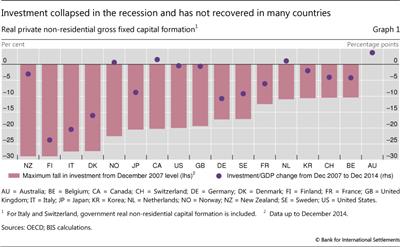
IMF pointed out that the first quarter was a  'shaky' one for the U.S. economy. Revised IMF growth forecast was down to 2.5 percent for 2015.  Data on the labor market has steadily improved with the job growth averaging  about 250,000 per month.  Cheaper oil prices may boost consumption . However, delay in  the housing recovery and the strong dollar  may keep the inflation pressures quiet  so that the Fed needs to raise rates in the last quarter. Global investment activity indicates that even easy liquidity policy is not enthusing investment.
Source - BIS Statistics


Russia and Qatar could lose the right to host the 2018 and 2022 World Cups if evidence is found of corruption in the bidding process. About 14 FIFA officials and sports marketing executives are accused by US prosecutors of taking part in a sweeping kickbacks scheme going back 20 years involving a total of $150 million in bribes. Would sponsor corporate entities  be involved  and would they be sold off on world equity markets?


Gold seems to continue to be gathering dust.  
Emerging economies seem too hot for now. 
G7 meet in Germany seems to have a Russian contain agenda rather than economics. They will speak more on Ukraine and just a whisper  on Greece. 
Schloss Elmau, Germany G-7 Meet 

So the hesitant investor seems to  look to USD  assets for the coming week. When in doubt, get to the safe haven.


Without any risk or responsibility

Friday, June 5, 2015

Bundesbank says Germany on growth path

Bundesbank's expects Germany’s real gross domestic product (GDP) to grow by 1.7% 2015, 1.8% in 2016 and 1.5% in 2017. The expected increases are above the estimated growth rate in potential output of 1.2% per year, aggregate capacity utilisation should, according to the Bundesbank's experts, rise markedly and considerably exceed the normal level by the end of the forecast horizon. This means that labour market reserves will be mobilised and wages will rise  strongly in the medium term.  

Without any risk or responsibility  

Square positions mean less tense weekend...

It seems  too risky to keep open positions over the week end even if you have  the authority from your boss and  back office to so do!!!

The Greeks are rather sensitive and defiant.  They have decided that they need to keep the money with themselves. If  the outstanding sums are large, the deliberations have greater seriousness!

Merkel is looking for 'numbers' in the end.  The Germans are rather disappointed at having to dole out the Greeks.

The bond market seems rather volatile(volatility is probably where you make your money) but then the weekend is too long to have long positions. 

The European banks ranging from HSBC to Lloyds seem to leave lingering doubts in the insecure minds of the investor. 

The US economy sends out mixed signals. The IMF  pleads with US  not to raise the interest rates in the fall. But "if winter comes, can spring be far behind" ? The Fed has been considerate but would be driven by data and not IMF pleas.

So the FIIs have to leave the emerging economies some day,  soon and with the oil glut, Indonesia and Venezuela are examples of how the cookie crumbles. 

Australian stocks haemorrhaged, shedding $70 billion over the week in worries over the stalling domestic economy and that piled on  a global bond sell-off to hit local equities . It might take some time for the Aussies to restore confidence.


Without any risk or responsibility