Showing posts with label Economy. Show all posts

Monday, February 15, 2016

The paradox of the share market

Global share prices fell by almost 10 per cent over January[1]. This is even as commodity prices have been falling. Rationally one could expect that as input costs fall, cost of production and prices must consequentially fall, making it a stimulus for  consumer demand.  An increased demand from consumers  should have seen equity prices rising.  
However, in the recent instance, equity prices have fallen. This is even as economies strive to rebalance-  away from the resources sector towards non-resource sectors; away from mining and manufacturing to service sectors.
Growth in the services sector, should be welcomed as long as growth is labour-intensive; but the ability of the sector  to bring about voluminous employment  changes look bleak.  Given the technological intervention in the sector, a rise in employment is not a concomitant to growth. This unemployment bulge should lower labour costs and enhance competitiveness and encourage businesses to employ more labour. Goods-related production ought to go up .
All this does not seem to happen.   What moves markets today are sentiments rather than economic fundamentals.   


Central banks have limits. 


This blog recommends no investment. All views are without any risk or responsibility. 


[1] Reserve Bank of Australia,

Wednesday, January 6, 2016

Winter in markets...

'Freezing in Fear' Factors:


  • Chinese growth slippage.
  • Slide in the yuan.
  • Japanese recessionary inclination, coupled with strengthening yen - which is seen as a safe haven. 
  • Australian commodity price falls.
  • North Korean atomic exploits.
  • China vs Vietnam.
  • Gulf affected by downhill oil prices.
  • Europe's economic problems seem to linger.
  • Political disunity in Europe. The burden on Germany and France owing to geopolitical tensions. 
  • Post 2011 chaos in the Middle East.
  • An imperious Russia seeking to reassert.
  • Saudi Arabia versus Iran. Sectarian divisions on religious lines. 
  • A slow moving India where internal dissensions hold up governance and reforms.
  • Volatility in the markets. (Cause and effect)
  • Stress in the financial sector.
  • Services industry slowdown owing to geopolitical moves. 
  • Appreciation of the dollar and a global slowdown might affect USA. 


The views expressed are without any risk or responsibility.


Thursday, October 15, 2015

RBA's Financial Stability Report voices concerns:

Reserve Bank of Australia in its latest financial stability review report points to some countries  such as Brazil, India, Indonesia and  have increased their foreign currency borrowings in recent years. 
"Depending on whether and how they hedged, the profits of some corporations might come under pressure because of domestic currency depreciation... and slower economic growth."

The Report also points out that increased exposures of advanced economy investors to emerging market corporations and sovereigns in recent years may be a channel through which financial stresses in emerging markets spill over to advanced economies.


Liquidity risk might be underpriced by some investors.

There is apparent over-investment in some sectors of the Chinese economy such as real estate and heavy industry
Risks in China are particularly prominent for highly leveraged firms, including some firms in the oil and gas industries that are exposed to a decline in energy prices and construction firms that have raised significant foreign currency denominated bond funding in recent years.
Many Chinese local governments have large debts, and land sales account for a sizeable share of their revenues

(Note: Emphasis ours) 
Reference: http://www.rba.gov.au/publications/fsr/2015/oct/pdf/global-fin-env.pdf

Friday, May 29, 2015

Economic worries on US Floods

The United States, which is the key force in global growth might see a deceleration in growth this quarter owing to the effect  of adverse weather conditions. Floods have hit Texas and Oklahoma. Household spending – would naturally be affected. There will have to be rebuilding . There have been losses suffered and a $1.4 trillion-a-year Texas economy which is also location of US' main source of energy has incurred losses.  

That is a blow impacting  the US assets and  the dollar, temporary though. 


Monday, May 18, 2015

Australia : Case of A Resource Based Economy

Excerpts from the Speech of Philip Lowe , Deputy Governor, at  the Corporate Finance Forum, Sydney – 18 May 2015

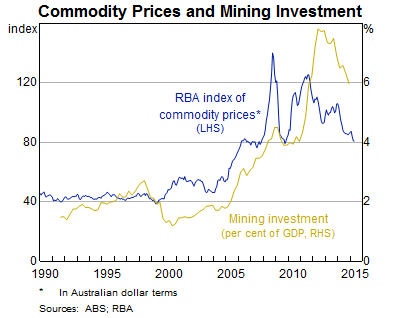
"...(L)argely on the back of strong growth in China... investment in the resources sector in Australia picked up considerably to take advantage of these high prices and Australia's endowment of natural resources, especially iron ore, coal and natural gas. These developments, which were interrupted briefly by the financial crisis of 2008 and 2009, can be seen clearly in this first graph . By 2012, mining investment, as a share of GDP, peaked at its highest level in at least a century.


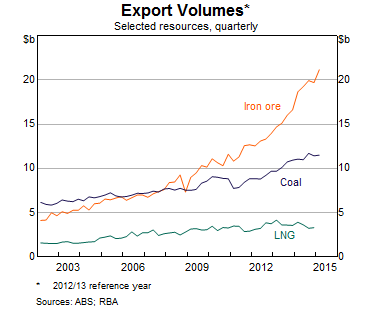
In 2014, the tonnage of iron ore exported was double that of five years earlier, while the tonnage of coal exported was up 40 per cent over this same period. There has also been growth in LNG exports, although the really big increases still lie ahead of us. All up, growth in resource exports has contributed around 1 percentage point to annual GDP growth 


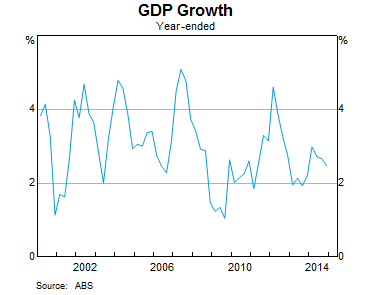
Over the past three years, GDP growth has averaged around 2½ per cent, and the RBA'slatest forecasts, which were released around 10 days ago, have this type of growth continuing for a while yet (Graph 3). While in many other developed economies, growth of 2½ per cent would be viewed fairly favourably, it is below what we have become used to in Australia and it is below what we are capable of. As a result, there has been a build-up of spare capacity in the overall economy


.


Source: Reserve Bank of Australia


Without any risk or responsibility

Sunday, March 22, 2015

BIS Study on (Why) Is Investment Weak?

A  BIS  study[1] opines that business investment has remained low in spite of unusually easy financing conditions globally. Highly expansionary monetary policies have resulted in  (a) low interest rates in capital markets, (b) with corporate bond spreads at close to historically low levels  (c)  capital market borrowing has been   cheap, including for riskier borrowers, and also widely accessible (d) equity markets in   advanced economies have risen substantially in an environment of low interest rates and strong risk appetite.
A plausible, explanation for slackness in investment is that even if firms do have funds to invest, they are too uncertain about future economic conditions and so whether the possible return on investment will justify its cost.  


[1] (Why) Is investment weak? by Ryan BanerjeeJonathan Kearns and Marco Jacopo Lombardi
BIS Quarterly Review, March 2015 18 March 2015


Sunday, November 23, 2014

Gold, China and Euro

With the Chinese and Euro talk and moves towards further stimulus to avoid deflation, gold seemed set to strengthen. The People’s Bank of China cut the one-year benchmark lending rate by 40 basis points to 5.6% and the one-year deposit rate by 25 basis points to 2.75%. This is expected to accelerate Chinese growth and thus shore up gold. The submission here is that it can only be technical buying and not sustained buying as 

a) deflation is the global worry, not inflation;
b) China might yet take time to restore its high growth rate;
c) India has introduced Kisan Vikas Patra bonds which will see unaccounted money flow in to that route and not so much in to gold;
d) oil prices are weak and oil sellers would hesitate to invest in gold for some time yet;
e) Swiss referendum looks set to be not so benign for gold;
f) Russian buying at this point looks more geo-political rather than pure economics.

It may be a good idea for the day to sell and buy. 

Tuesday, October 28, 2014

ECB is it putting its act together?

Finally, we have news of ECB  in action. We see efforts to depreciate the euro by lowering interest rates and compelling an exit from the currency. That should the European industry good.
We also hear of asset expansion by ECB; bold moves from a conservative central banking institution which has to take on board 18 national interests!
However, ECB  has to be aggressive ; a few billions may not suffice ; if it hesitates, it might affect Europe and global markets. 

Monday, October 20, 2014

China growth does not convince...

Asia's markets shrugged off the Chinese GDP figures, the weakest in post 2009 . Expectations of European equity markets following last evening's Dow on an upward move seems rather a hope. Unless the ECB continues aggressively with a stimulus programme, Europe has no real economics to back such a surge at this point. A strengthening of Euro may further dampen shares.
Europe may rise marginally  but has by the end level off or cede space.

Costs of Ebola

The economic costs of Ebola are grim. As the World Bank worries , IMF  would have to revise downward growth figures for Africa. There is virtual shutdown of these countries, Doing business will be a difficult prospect. Airlines will suffer losses. Worst case scenario costs may be up to 2015 are estimated at USD 32.6  billion by the World Bank. If only Africa had this type of money for growth! Europe will suffer quite a bit as it has traditional links and business with Africa.