Showing posts with label Australian Dollar. Show all posts

Monday, November 30, 2015

It makes sense to buy the Australian dollar...

The Australian dollar is gaining market confidence . The innate strength of Australia as a resource based economy helps, and there will be structural shifts which are already sending out positive signals for the economy. 
Australia's quality emphatic  migration policies results in  an increase in  labor endowment. This will cause an outward shift in the qualitative and skill intensive labour supply . The Aussie production curve could  shift  positively in favour of   labour intensity as a factor of production.  An example may be in deepening skill intensity Australian education quality is high.  Some of Asia's best universities are in Australia. In an Asian age, Australia serves the as a destination for the Asian elite. Given that the Japanese economy is in throes of another bout of technical recession, the Aussie is a good alternative.
The Chinese are quite fond of Australia and will keep on diversifying their portfolio into Australia with each rise. 

This blog makes no recommendations for investments. All views expressed here are without any risk or responsibility. 

Sunday, July 5, 2015

A Long day for shorts... dollar is the king...

Congratulations , Greece.
Figures published by the Greek  interior ministry indicated 61% of those whose ballots had been counted voting "No", against 39% voting "Yes".

The statement of the Eurogroup President following the referendum was "I take note of the outcome of the Greek referendum. This result is very regrettable for the future of Greece. For recovery of the Greek economy, difficult measures and reforms are inevitable. We will now wait for the initiatives of the Greek authorities. The Eurogroup will discuss the state of play on Tuesday 7 July." Lack of reconciliation was writ large on a terse statement. 


The euro has quite a South road to traverse. As predicted here, Australian dollar started the rout. Commodity prices will fall. Oil and Gold should follow commodity prices south.Yen may hold on.  The dollar is the king. Chinese turmoil may accelerate falls. It is a long day for the short of it. 

Without any risk or responsibilty."

Monday, June 29, 2015

Reserve bank of Australia Statistics

Reserve Bank of Australia (Release date: 30 June 2015)  data indicates business loans went up by 0.4 percent although there was a slight fall in personal credit. 
Financial AggregatesPercentage change
MonthlyYear-ended
Apr 2015May 2015May 2014May 2015
Sources: ABS; APRA; RBA
Total credit0.30.54.76.2
– Housing0.50.56.27.2
– Personal-0.1-0.10.40.8
– Business0.00.42.85.2
M30.6-0.17.06.5
Broad money0.7-0.16.6
Note:
M3: Currency plus bank deposits of the private non-bank sector, excluding Commonwealth and State Government deposits and interbank deposits. Seasonal adjustment by the Australian Bureau of Statistics.  

Without any risk or responsibility

Sunday, June 7, 2015

The Long and the Short of It : Crystal Gazing the market for the week


The Long and the Short of the Markets:

Markets seem likely to be more volatility prone this week .

The moment of truth moment for Greece with the probability of a debt debacle  and the Europeans' frustrating lack of consensus.

Australia is languishing in the Chinese shadow. The number of people trapped in long-term unemployment in Australia hit a 16-year high,  unemployed for a year or more has risen by 18 per cent over the past year to 188,000 ; that is almost three times more than mid-2008. Yet Melbourne and Sydney property prices are high, possibly because the Chinese are letting go off domestic property to invest in Australia , riding on the back of a falling Australian dollar which is being encouraged further south.

 John Cryan in Frankfurt as  CEO of  Deutsche ,  (replacing Jain and Fitschen in the latest of a series of leadership crisis among Western banks indicates how there is divergence between the governance of companies and investors expectations. . Banking stocks may see further pressures.

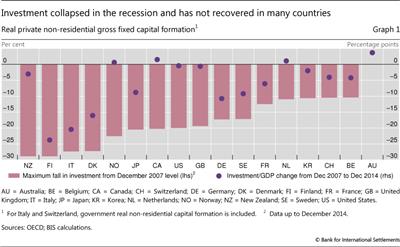
IMF pointed out that the first quarter was a  'shaky' one for the U.S. economy. Revised IMF growth forecast was down to 2.5 percent for 2015.  Data on the labor market has steadily improved with the job growth averaging  about 250,000 per month.  Cheaper oil prices may boost consumption . However, delay in  the housing recovery and the strong dollar  may keep the inflation pressures quiet  so that the Fed needs to raise rates in the last quarter. Global investment activity indicates that even easy liquidity policy is not enthusing investment.
Source - BIS Statistics


Russia and Qatar could lose the right to host the 2018 and 2022 World Cups if evidence is found of corruption in the bidding process. About 14 FIFA officials and sports marketing executives are accused by US prosecutors of taking part in a sweeping kickbacks scheme going back 20 years involving a total of $150 million in bribes. Would sponsor corporate entities  be involved  and would they be sold off on world equity markets?


Gold seems to continue to be gathering dust.  
Emerging economies seem too hot for now. 
G7 meet in Germany seems to have a Russian contain agenda rather than economics. They will speak more on Ukraine and just a whisper  on Greece. 
Schloss Elmau, Germany G-7 Meet 

So the hesitant investor seems to  look to USD  assets for the coming week. When in doubt, get to the safe haven.


Without any risk or responsibility. 

Monday, June 1, 2015

Weakening Commodity Prices

Reserve Bank of Australia 

Index of Commodity Prices

May 2015

"Preliminary estimates for May indicate that the index declined by 1.6 per cent (on a monthly average basis) in SDR terms, after declining by 3.5 per cent in April (revised). Falls in the prices of coking and thermal coal contributed to the decline in May. The base metals subindex was little changed in the month, while the rural commodities sub-index fell. In Australian dollar terms, the index declined by 2.1 per cent in May.
Over the past year, the index has fallen by 19.5 per cent in SDR terms, largely driven by falls in the prices of bulk commodities. The index has fallen by 13.9 per cent in Australian dollar terms over the past year."


Without any risk or responsibility 

Saturday, May 30, 2015

The Long and the Short of It : The Week Ahead


The Long : Prospects  Good 
  • The OECD projects that the US will grow by 3.1 percent in 2015  and by 3 percent in 2016, 
  • UK is projected to grow at 2.6 percent in 2015 and 2.5 per cent in 2016. 
  • Canadian growth is projected at 2.2 percent this year and 2.1 percent in 2016.
  • Japan is projected to grow by 1 percent in 2015 and 1.4 percent in 2016.
  • The euro area is projected to grow at a 1.4 percent rate in 2015 and a 2 percent pace in 2016. 
  •  major euro area economies. 
  • Germany is forecast to grow by 1.7 percent in 2015 and 2.2 percent in 2016, France by 1.1 percent in 2015 and 1.7 percent in 2016, while Italy will see a 0.6 percent growth rate in 2015 and 1.3 percent in 2016. 
  • China is expected to grow by about 7 percent annually in both 2015 and 2016.
  • India will grow by 7.7 percent in 2015 and 8 percent in 2016.
  • Brazil’s economy is expected to shrink by 0.5 percent in 2015 before returning to a 1.2 percent growth rate in 2016.

 The Short : An equity market buy and a Japan buy Week? 

The United States,  the major driving force of global growth, has a decelerated  real GDP growth rate for the January-March quarter. This was  in part, due,  to effects of adverse weather conditions. The Texan floods add to economic impacting of nature further. Inflation is being held in check  by the slow recovery and, also by lower prices of imported goods as also the fall in oil prices. Unless there are clear indicators of a reversal, the Fed will not hike rates any time soon. 

Structural fragilities in Europe seem to persist. Europe may get its act together on the Greek tragedy, but its dithering and dallying policy makers are not so inspiring. A temporary truce is not likely to help and structural reforms seem so far away. France and Italy are still laggards to Germany. European banks seem to be too big to fail but seem arthritic in reactions with the agony of misfeasance.  

Global growth will have to be primarily led mainly by Asian  private demand, with  firm households spending. The Chinese economy remains sluggish against the backdrop of the deceleration in fixed asset investment and continued inventory adjustments. India is still slow on its reforms and its Prime Minister appears to be a lone ranger for infrastructural growth. Dreams to reality is India's challenge. Its central bank might reduce the interest rate this week but this might have already been factored in last week by investors. Further, the transmission mechanism is slow and halting. Its bureaucracy is sluggish and archaic so FDI will be slow and in fits. China  is ahead of India by at least a decade, (although "Comparisons are odious palabra' said Shakespeare). The fact remains that the Indian Government is aware that it has to accelerate growth through infrastructure trigger. 

Commodity exporting economies like Australia are  yet to gain  momentum.Mining firms are likely to cut investment against the backdrop of sluggish  demand. Australia has become so China linked that it is  waiting for the Asian giant to lead. The Australian unemployment rate  is forecast to rise further and wage growth is unlikely to move up, thus affecting purchasing power or saving potential. The official stance seems to be to talk the Aussie dollar down.   

Crude oil prices might  rise a shade on political tensions in the Middle East and uncertainty in US (read Texas ) supplies but is likely to be  pulled  back because of the 30 million barrels of oil per day supplies yet to meet equivalent demand. The weaker economies among the oil suppliers  open up their taps  on the sly  to meet internal income demands; so the price of WTI might languish at around $60 per barrel. 

There is little to revive gold - neither inflation nor Asia seems poised to extend a hand. India's ambitious gold deposit scheme might, if it takes off, add in volumes to the supply and might off set any rise in the global  gold demand. India's many temples, if not households,  could  monetize gold. So supply side economics will keep gold prices down for quite some time. 


Europe has been  the epi-center of the global bond-market quake since mid-April. About  $375 billion was wiped off the value of euro-zone-government bonds when prices fell abruptly after rising for several months to record levels. So investors might be hesitant to return to bonds so soon.There are monetary policy excesses at play. Players like the Swedish central bank (Riksbank) face a risk of bond shortages as they intend to enhance market liquidity. Substituting sovereign with mortgage bonds might just about fuel a bubble in the housing market. 

So the short of it is that equity markets might host investors this week despite possible volatility. Japan looks to be the week's favourite economy with some dissipation of the deflation sentiment in view. The tremors off its coast may not have had much of an economic  effect. 


Without any risk or responsibility on the part of the author. 

“We’re in the dark like everybody else on this. We don’t have any information at all, a lot of curiosity.” (Richard Hart, Police Chief , Yorkville)

Monday, May 18, 2015

Australian Reserve Bank's outlook

Excerpts from Minutes of the Monetary Policy Meeting of the Reserve Bank Board
Sydney – 5 May 2015

Growth of Australia's major trading partners had eased a little in the early months of 2015, but was forecast to remain close to its long-run average in 2015 and 2016. Weaker growth in China in the March quarter, which had also been reflected in lower bulk commodity prices and hence a slightly lower terms of trade

The Chinese property market had continued to be a source of weakness in the economy and represented a key source of uncertainty for the outlook, both through the effects on demand for industrial products and on the finances of local governments that relied on land sales to fund infrastructure projects.
Residential property prices had continued to fall, albeit at a more gradual pace, and sales were lower than in the previous year. Chinese demand for steel had eased and had been accompanied by a fall in Chinese iron ore production and relatively flat imports of iron ore, although Australian iron ore exports to China continued to grow.  
Although the prices of iron ore, thermal coal and oil prices had rebounded somewhat from recent lows, members observed that the slowing in the growth of Chinese demand for steel had contributed to declines in the prices of bulk commodities since the start of 2015.   


US economy had moderated in the March quarter, largely reflecting the temporary effects of disruptions related to severe weather and industrial action in West Coast ports. Over the same period, conditions in the labour market had continued to improve. Non-farm payrolls employment had continued to grow strongly over the past six months and the unemployment rate had declined further. The Federal Open Market Committee (FOMC) had indicated that it was likely to begin the process of normalising interest rates in the second half of the year as long as economic conditions continued to evolve as expected.
Growth in the Japanese economy looked to have been modest in the March quarter and there were signs that tight labour market conditions were generating stronger wage growth.
In the rest of east Asia, growth of both exports and domestic activity appeared to have slowed a little in the March quarter.
Economic activity in the euro area had continued to recover gradually over past few months.

In the United States, market pricing continued to suggest that the first increase in the US policy rate could be closer to the end of the year, and the subsequent pace of policy tightening could be slower than that envisaged by members of the FOMC as published in mid March.

On balance, taking all these factors into account, the Board decided that the best course was to ease monetary policy further at this meeting. 

Source: Reserve Bank of Australia,  
emphasis ours. 

Without risk or responsibility


Monday, April 13, 2015

Australian dollar and its Chinese connection

The Chinese data reflected imbalances in the second largest economy of the world. Australia has become so China centric that weak Chinese data took the Aussie down. Glen Stevens must be happy.

*
Although Greece is old news, France and Germany seems to taking steps to lead their individual economies on to faster growth. That augurs well for Europe.
*
Smart watch and Apple are indicators of how advanced the US is on technology front.


Without any risk or responsibility. 

Sunday, April 12, 2015

Aussie being talked down further by Glenn Stevens

Statement by Glenn Stevens, Governor: Monetary Policy Decision

Reserve Bank of Australia:

"The Australian dollar has declined noticeably against a rising US dollar over the past year, though less so against a basket of currencies. Further depreciation seems likely, particularly given the significant declines in key commodity prices. A lower exchange rate is likely to be needed to achieve balanced growth in the economy."


Without any risk or responsibility

Wednesday, March 11, 2015

Australia: Growth with Inequity

Some recent data released by the Reserve Bank of Australia (RBA) has some supportive to growth and some worrying indications.
Labour Productivity has been rising (+)

Since 2012, Unemployment has been growing(-)


Average earnings and labor costs  have been falling:(-)

The indications are that Technological productivity will push push up growth: there will be more from machines than from men. So real incomes may not increase but  company progfits may increase.


Views expressed without any risk or responsibility. 

Monday, March 2, 2015

Australia leaves rates unchanged; expects Aussie to fall further.

Reserve Bank of Australia - RBA- left rates unchanged despite not a too great outlook. According to the Governor: (Excerpts)
  • Growth is continuing at a below-trend pace, with domestic demand growth overall quite weak.
  • Unemployment rate has gradually moved higher over the past year.
  • Spare capacity.
  • Growth in labour costs subdued.
  • Inflation will remain consistent with the target over the next one to two years, even with a lower exchange rate.
  • Credit is recording moderate growth overall, with stronger growth in lending to investors in housing assets.
  • Dwelling prices continue to rise strongly in Sydney, though trends have been more varied in a number of other cities over recent months.
  • Other asset markets, prices for equities and commercial property have risen, in part as a result of declining long-term interest rates.
  • The Australian dollar has declined noticeably against a rising US dollar, though less so against a basket of currencies. 
  • It remains above most estimates of its fundamental value, particularly given the significant declines in key commodity prices. A lower exchange rate is likely to be needed to achieve balanced growth in the economy.


Our Comments: The dollar is being talked down. There seems to be bubble coming up in the housing market. With Chinese active in this area and with China slowing, there is a real fear of an asset risk here. 


Without any risk or responsibility. 

Wednesday, February 25, 2015

Australia has falling Capital Expenditure...


New Capital Expenditure, in volume term
The seasonally adjusted estimate fell 2.2%.


Source: Australian Bureau of Statistics


This blog author is of the view that with Chinese slowdown, Australia may face a further fall in its asset values and currency.

Views expressed without any risk or responsibility:


Sunday, February 15, 2015

Is RBA talking down the Australian Dollar?


"Against a basket of relevant currencies the Australian dollar has fallen by less, but the decline is still about 11 per cent since August. Further adjustment is probably going to occur."
Governor Glen  Stevens on 13 February 2015

Our Comments:

With business investments peaking in 2011 - 2012 and since then falling,  Australia is unlikely to be in any comfort zone any soon.

Business Investments  y-o-y percent changes

2011
Q3
20.09
Q4
15.72
2012
Q1
16.49
Q2
18.54
Q3
9.59
Q4
12.14
2013
Q1
1.65
Q2
-0.33

2014
Q1
-3.14
Q2
-5.47
2011 to 2014

Source: OECD
Business Investments  y-o-y percent changes


The resource based Australian economy  has seen a reversal of its high investment period mirroring a slowdown in the Chinese economy. With the falls in prices for export commodities has affected, apart  from the  terms of trade turning adverse, the incomes both present and potential  have come down thus restraining the  purchasing power.  The adverse income growth have lowered revenue flows to mining companies and revenues for both state and federal governments.  There is a consequential fall in incomes of households.  The fall in oil prices, does increase the real incomes of consumers, but fears of a recession and rising unemployment  holds spending back.
Dwelling construction which had been rising strongly  may have to slow  down as Chinese investments slow.  

Increased asset values, which push up gross measures of wealth, and low interest rates are also working to push consumption up relative to income.
By the Reserve Bank of Australia's view, non-mining business investment spending and public sector spending are also subdued.

All this has resulted in a fall in the Australian dollar. This should help restructure the Australian economy towards a greater contribution by Education and Tourism sectors. The lower exchange rate should help export volumes    in these sectors. Overall, growth in non-mining economic activity has picked up, but is still a little below average.

Against the US dollar has fallen by around 17 per cent .   

Australian dollar may like to fall further to boost Education and Tourism

Thursday, February 5, 2015

Of rates and rat races...Australia has worrying political factors too...

A secret 'spill' ballot is likely on coming Tuesday - this raises issues  on the continuance of Prime Minister Abbott. Abbott, under fire for economic management failures, (among others) has to stand up to an internal party rebellion.There is a race for leadership...

With economic forecast of a slowdown and the rate cut by the Reserve Bank of Australia indicating worries over a slow/ slowing economy ; this leadership challenge will put the Australian dollar under further pressure at least until early next week.

Indian miner entrepreneurs like Adani may also be under pressure.

Oh Chinese, oh Chinese, thou little knowest the damage that thou hast done to Australia.


Views expressed without any risk or responsibility. 

Sunday, February 1, 2015

Australia- the Chinese and Commodity Connections

The Australian currency is falling and by doing so is perhaps doing good to the economy which is under pressure from falling commodity prices and slowing China. Chinese growth being slow might affect / has already affected Australian assets adversely. Latest reports even suggest that economic growth has slipped from an annualised pace of 3.6 per cent to 1.6 per cent.A year ago the average quarterly unemployment rate was 5.8 per cent, but hit 6.2 per cent in the December quarter, the highest in 12 years.

Output growth of about 3% is expected for 2014 and 2.5% in 2015.


House prices have reportedly grown by about 10% over the past year. Construction activity has been spurred by both speculative element and overseas growth inspired  demand.  Strong prudential regulation help but a  concentrated financial sector  raise  concerns about competition.

The young Australians seem to need to work even more: with demographic profile indicating an ageing population. The 15-64 is falling and the 65 +is rising to over 15 %. This has productivity concerns. 

OECD estimates are as follows:


AUD bn.
2012
2013
2014
2015
2016
GDP
 1 452.8
3.6%
 2.4 %
3.1 %
2.5 %
3.0 %
Source: OECD     
 Net foreign debt is estimated at  about 55% of GDP. 

The latest Economic Survey too backs up that expectations are of a slowing Australia.
Economic Survey data for Australia
2.9
 2.8
 7.3
 2.2
3.3
2.6
 -5.8
7.4
4.1
2.6
Australia
GDP
FY 2013/14
%
Australia
GDP
FY 2014/15
%

China
GDP
Year to Dec
2014 %

US
GDP
Year to Dec
2014 %
World
GDP
Year to Dec
2014 %

Household
spending
Year to Dec
2014 %

Business
investment
Year to Dec
2014 %

Housing
investment
Year to Dec
2014 %
Nominal
GDP
Year to Dec
2014 %

CPI and wage
price growth
Year to June
2015

With unemployment at 6 % and current account at -2.8 %, Australia is under pressure. 

Views expressed without any risk or responsibility.


Monday, January 5, 2015

Cut loss day for emerging markets?

Australian and Kiwi stocks are battling the bears. Australian banks are also perhaps facing swap bill rate fixing scandal charges- so it looks a bleak sellers day in the East. There is not much until New York to inspire a dyke in this great day of cut losses. That Yen, representing an economy in deflation for several years, is seen as a safe heaven speaks volumes that investors have less and less space to run to.
Europe's dilly dallying is costing the World money. Germany, instead of leading, is restraining ECB and Draghi has been trying all that he can - speak the euro down. Europe is now facing a possibility of Greece exit - had it been some three years ago, it may have helped- 3 years down the road, one has to pay back with interest...

Oil prices have fallen further, as predicted here. With Iraq pumping more to make both ends meet, mid east economies are severely vulnerable. There should be massive drops on Mid East bourses as oil flounders at $ 50.

It looks like high dollar, high yen , low Euro, low Asian currencies, low Latin American currencies. Kuwaiti currency, Dinar would be under severe pressure as it takes on the first of the impact. Commodities have nowhere to go today, it looks.

Emerging markets, there is the worrying wind ; it sounds like a stormy day.

Views expressed without risk or responsibility. 

Sunday, December 14, 2014

Bloomsberg reports Australian budget gap widens...

http://www.bloomberg.com/news/2014-12-15/australia-s-budget-deficit-widens-to-a-40-4-billion-on-iron-ore.html (Michael Heath and Jason Scott)

Commodity price falls are impacting adversely. As revenues fall and fisc is constrained,  unemployment will rise by mid 2015 to 6.5 %. The Reserve Bank's hope of a falling currency is coming in faster. The most worrying is that it is the worst 'terms of trade since 1959'...

Thursday, December 11, 2014

Aussie Reserve Bank Guv says Aussie must fall further...

He suggested Aussie Dollar should be around  US75¢.

read: 

http://www.afr.com/p/national/glenn_stevens_interview_the_full_FiihZ41I8IrOls4Yh6D8wK

Sunday, December 7, 2014

Oil's Slide: The good and bad news...

Oil has been sliding today too. It might for some more time.The good news is that there is a real lowering of input costs for manufacturers. Economies under a threat of recession should heave a sigh of relief as an unexpected source. Consumers would see their real incomes rise. They could then buy more which is a great thing to happen to fast moving consumer goods. Natural gas should see a concomitant fall too. This should be welcome news for manufacturers.

Oil revenue earners will see falls in spending. Economies like Indonesia, Venezuela and Rusiia would be the worst hit. Europe is affected by Russia. Add to that geopolitical tensions created by a weak Russia  will threaten European trade and markets. Asian markets , in the South East might be affected by the dollar increase. It is possible that Malaysian ringitt and Thai baht would be under severe pressure. A weakening of China will pressurise the Aussie dollar to lower levels.When in doubt, investors will flee to dollar assets. That is negative for the Latin Americans. Local investors will flee too from theses emerging markets in to US Dollar assets.  BRICS looks wavering. ECB is still debating when and with December here, no firm decisions are likely prior to the New Year.

So we might see gold and other commodities continue to be in a bearish mode, with Asian stock markets slowing. Indian stock markets looks a bit carried away by sentiments as there is little to back up the eagerness for reforms.

An overall seller day but for USA buyrs may outnumber sellers. Some hope beyond Atlantic.