Showing posts with label BIS. Show all posts

Sunday, June 28, 2015

Achtung! BIS calls the current global system a 'malaise'... is a rout in the offing?

BIS, (Bank for International Settlements) in its latest report says (Excerpts here)
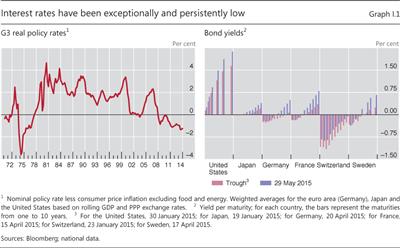
" Between December 2014 and end-May 2015, on average around $2 trillion in global long-term sovereign debt, much of it issued by euro area sovereigns, was trading at negative yields. At their trough, French, German and Swiss sovereign yields were negative out to a respective five, nine and 15 years. Such yields are unprecedented. "


"Policy rates are even lower than at the peak of the Great Financial Crisis in both nominal and real terms. And in real terms they have now been negative for even longer than during the Great Inflation of the 1970s. Yet, exceptional as this situation may be, many expect it to continue. There is something deeply troubling when the unthinkable threatens to become routine."
Such low rates are only the most obvious symptom of a broader malaise,..."
"We argue that the current malaise may to a considerable extent reflect a failure to come to grips with how financial developments interact with output and inflation in a globalised economy. For some time now, policies have proved ineffective in preventing the build-up and collapse of hugely damaging financial imbalances, whether in advanced or in emerging market economies (EMEs). These have left long-lasting scars in the economic tissue, as they have sapped productivity and misallocated real resources across sectors and over time."

Our Comments: Are we seeing a weary central banking; or a monetary fatigue? Is it that they are desolate? is it a prediction of a slippage to economic intensive care?


Without any risk or responsibility.

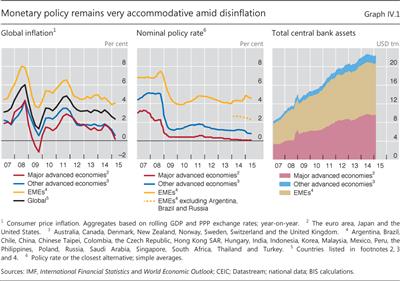
BIS says Monetary policy has been exceptionally easy ; cautions on risks of accommodation

"the ultra-low policy rate environment was reinforced with large-scale asset purchase programmes....
The deviation of inflation from expected levels and questions surrounding the sources of price changes underscore an incomplete understanding of the inflation process, especially regarding its medium- and long-term drivers. 

At the same time, signs of growing financial imbalances around the globe highlight the risks of accommodative monetary policies. The persistence of those policies since the crisis casts doubt on the suitability of current monetary policy frameworks and suggests that resolving the tension between price stability and financial stability is the key challenge.  "

(Excerpts from BIS' Annual Report, June 28, 2015)

Thursday, April 23, 2015

Operational Risk: The vulnerability of the system


  • A solo trader and a computer programme!
  • A fraudulent mind ad a lagging regulator!
  • From Nick Leeson to Navinder Singh Sarao, financial institutions are struggling with human resource risk.
  • If you have a fraudulent mind and a manipulatable algorithm, nothing in this market is real. It is then an unreal, manoeuvrable  market where the figures are exaggerated and in control of some criminal intent trader.
  • It is a failure of values in the financial world and the helplessness of a  supervisor.From LIBOR  fixing to mis-selling to to 'flash crash' , UK  seems to be  the host to valueless finance. 

"Bank supervisors cannot prevent all fraud or illegal conduct or forestall all undesirable behavior in large, complex financial institutions. But we can help create more resilient, less complex, and better managed organizations that promote, rather than undermine, financial stability."[1]


All the BIS guidelines on operational risk cannot eradicate fraud.  Let the investors beware.

[1] Testimony by Mr William C. Dudley  President and Chief Executive Officer of the Federal Reserve Bank of New York, before the Senate Committee on Banking, Housing, and Urban Affairs Financial Institutions and Consumer Protection Subcommittee, Washington DC, 21 November 2014.

Monday, March 23, 2015

Why Draghi may not be supported by future expectations...

Extracts from a Speech by Mario Draghi, President of the ECB, made a speech at  Brussels, on 23 March 2015 to the European Parliament’s Economic and Monetary Affairs Committee in which he stated the following:
 " Indeed, the banks covered in our Bank Lending Survey confirm that the easing of lending conditions is progressing hand-in-hand with a resurgent demand for credit to finance business investment. In the longer-term perspective, this will increase potential output.".


Read this hope against a BIS Paper (Why) Is investment weak? by Ryan BanerjeeJonathan Kearns  and Marco Jacopo Lombardi, 18 March 2015

"Expectations of future economic conditions appear to be more important in driving investment decisions. In most economies, a reduction in uncertainty about future economic conditions has boosted investment, but in Europe uncertainty has seemingly intensified, restraining investment. "
So Draghi may have good intentions  but will investors respond ? Do circumstances in the economies of Europe (Greece, Spain, France, Portugal) permit an optimistic outlook? A cost inefficient (read rather closed  Europe) may see corporates moving out to Asia and even USA Are we expecting too much in the 'wisdom late comer QE'?


 Without risk or responsibility

Sunday, March 22, 2015

BIS Study on (Why) Is Investment Weak?

A  BIS  study[1] opines that business investment has remained low in spite of unusually easy financing conditions globally. Highly expansionary monetary policies have resulted in  (a) low interest rates in capital markets, (b) with corporate bond spreads at close to historically low levels  (c)  capital market borrowing has been   cheap, including for riskier borrowers, and also widely accessible (d) equity markets in   advanced economies have risen substantially in an environment of low interest rates and strong risk appetite.
A plausible, explanation for slackness in investment is that even if firms do have funds to invest, they are too uncertain about future economic conditions and so whether the possible return on investment will justify its cost.  


[1] (Why) Is investment weak? by Ryan BanerjeeJonathan Kearns and Marco Jacopo Lombardi
BIS Quarterly Review, March 2015 18 March 2015


Sunday, March 15, 2015

Dollar rise: Risks for US Dollar borrowers and their bankers

"At end-September 2014, credit in US dollars to non-financial borrowers outside the United States totalled $7.3 trillion, an increase of 9.3% over a year earlier. Bank loans in US dollars to non-US non-financial borrowers rose 9.7% in the year to September 2014 to $4.9 trillion, while securities issued by these borrowers rose 8.6% to $2.4 trillion. When non-bank financial borrowers are added, the total comes to $9.2 trillion. The latter figure may give a better picture of non-resident US dollar credit, since many of these non-bank financial entities provide dollar funding directly to non-financial corporations."[1]

Our Comments:
With the dollar on a fast, upward move, repayment risk and re-pricing risk of dollar denominated loans should be causes of concern for banks and for emerging economies. Funding dollar loans is going to be a major problem for corporate borrowers in economies from China and India to Latin America. Emerging economies and bankers ought to be worried; so should regulators prepare!

Views expressed are without any risk or responsibility


[1] Global liquidity: selected indicators , Bank for International Settlements

Tuesday, October 28, 2014

Money Laundering : Western Banks thrive at cost of emerging economies?

The list of Indian black money submitted to the Supreme Court (of 627 names) apparently is of account holders of the HSBC . That calls for some reflection on corporate and transnational ambiguity.

It is interesting to note that HSBC (Mexico related) reportedly was involved in ignoring possible money laundering transactions pertaining to non monitored wire transfers and foreign currency. It also violated sanctions against governments of Iran, Libya, Sudan, Cuba. HSBC paid up nearly $1.9 billion  in 2013 towards these charges in a compromise deal with the investigators.

Where are the Basel Committee's (BIS) KYC norms? Where are the corporate governance norms so much preached about? If you are a transnational bank and you publicize corporate social responsibility, does it give you a right to abet crime?

Regulators in the West indeed seem to be soft on these banks. When corrupt regimes of emerging economies join powerful and deceitful bankers, truth is smothered!!!