Showing posts with label Inflation. Show all posts

Monday, July 20, 2015

The return of Gold as an investment avenue might synchronize with the Fed hike...

If the Fed expects
full employment and
it senses growth on track, and
it sees a likely raise of the inflation head and
it increases the interest rates,
then gold investors might see stability.
As the higher the expected price rise, the better gold as a hedge.
In emerging economies, interest rates have to move up  to attract investment and there could be money price  induced real inflation. 
Gold then becomes a stabilizer.


Note: This blog offers no investment advice. The views expressed here are without any risk or responsibility. 

Thursday, July 2, 2015

Some price rise!!!: OECD annual inflation up to 0.6% in May 2015


Annual inflation in the OECD area picked up to 0.6% in the year to May 2015, compared with 0.4% in April. This increase in the annual rate of inflation mainly reflected the slower decline in energy prices at -10.0% in May, as compared with -11.5% in the year to April.

Food price inflation slowed to 1.6% in May, compared with 1.8% in April. Excluding food and energy, the OECD annual inflation rate was stable at 1.6%.


Source: Consumer price indices, OECD

Sunday, June 28, 2015

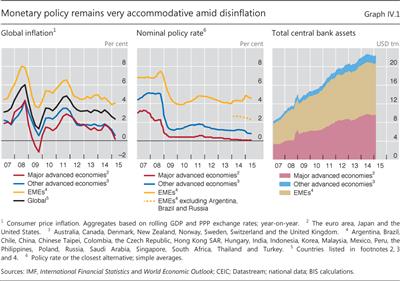
BIS says Monetary policy has been exceptionally easy ; cautions on risks of accommodation

"the ultra-low policy rate environment was reinforced with large-scale asset purchase programmes....
The deviation of inflation from expected levels and questions surrounding the sources of price changes underscore an incomplete understanding of the inflation process, especially regarding its medium- and long-term drivers. 

At the same time, signs of growing financial imbalances around the globe highlight the risks of accommodative monetary policies. The persistence of those policies since the crisis casts doubt on the suitability of current monetary policy frameworks and suggests that resolving the tension between price stability and financial stability is the key challenge.  "

(Excerpts from BIS' Annual Report, June 28, 2015)

Friday, June 5, 2015

Euro area bank interest rate statistics: April 2015


The composite cost-of-borrowing indicator for new loans to corporations  decreased by 4 basis points from the previous month to 2.30% in April 2015.

The composite cost-of-borrowing indicator for new loans to households for house  purchase decreased by 6 basis points from the previous month to 2.25% in April.


This was the 15th decrease in a row since February 2014.


Without risk or responsibility 

Tuesday, June 2, 2015

2 good bits of news for euro

German unemployment lowest since 1991
and there is Euro area annual inflation is expected to be 0.3% in May 2015, up from 0.0% in April , according to a flash estimate from Eurostat, the statistical office of the European Union.

 Looking at the main components of euro area inflation, services (1.3%, compared with 1.0% in April) is expected to have the highest annual rate in May, followed by food, alcohol & tobacco (1.2%, compared with 1.0% in April), non-energy industrial goods (0.3%, compared with 0.1% in April) and energy (-5.0%, compared with -5.8% in April).

Without any risk or responsibility 

Saturday, May 30, 2015

The Long and the Short of It : The Week Ahead


The Long : Prospects  Good 
  • The OECD projects that the US will grow by 3.1 percent in 2015  and by 3 percent in 2016, 
  • UK is projected to grow at 2.6 percent in 2015 and 2.5 per cent in 2016. 
  • Canadian growth is projected at 2.2 percent this year and 2.1 percent in 2016.
  • Japan is projected to grow by 1 percent in 2015 and 1.4 percent in 2016.
  • The euro area is projected to grow at a 1.4 percent rate in 2015 and a 2 percent pace in 2016. 
  •  major euro area economies. 
  • Germany is forecast to grow by 1.7 percent in 2015 and 2.2 percent in 2016, France by 1.1 percent in 2015 and 1.7 percent in 2016, while Italy will see a 0.6 percent growth rate in 2015 and 1.3 percent in 2016. 
  • China is expected to grow by about 7 percent annually in both 2015 and 2016.
  • India will grow by 7.7 percent in 2015 and 8 percent in 2016.
  • Brazil’s economy is expected to shrink by 0.5 percent in 2015 before returning to a 1.2 percent growth rate in 2016.

 The Short : An equity market buy and a Japan buy Week? 

The United States,  the major driving force of global growth, has a decelerated  real GDP growth rate for the January-March quarter. This was  in part, due,  to effects of adverse weather conditions. The Texan floods add to economic impacting of nature further. Inflation is being held in check  by the slow recovery and, also by lower prices of imported goods as also the fall in oil prices. Unless there are clear indicators of a reversal, the Fed will not hike rates any time soon. 

Structural fragilities in Europe seem to persist. Europe may get its act together on the Greek tragedy, but its dithering and dallying policy makers are not so inspiring. A temporary truce is not likely to help and structural reforms seem so far away. France and Italy are still laggards to Germany. European banks seem to be too big to fail but seem arthritic in reactions with the agony of misfeasance.  

Global growth will have to be primarily led mainly by Asian  private demand, with  firm households spending. The Chinese economy remains sluggish against the backdrop of the deceleration in fixed asset investment and continued inventory adjustments. India is still slow on its reforms and its Prime Minister appears to be a lone ranger for infrastructural growth. Dreams to reality is India's challenge. Its central bank might reduce the interest rate this week but this might have already been factored in last week by investors. Further, the transmission mechanism is slow and halting. Its bureaucracy is sluggish and archaic so FDI will be slow and in fits. China  is ahead of India by at least a decade, (although "Comparisons are odious palabra' said Shakespeare). The fact remains that the Indian Government is aware that it has to accelerate growth through infrastructure trigger. 

Commodity exporting economies like Australia are  yet to gain  momentum.Mining firms are likely to cut investment against the backdrop of sluggish  demand. Australia has become so China linked that it is  waiting for the Asian giant to lead. The Australian unemployment rate  is forecast to rise further and wage growth is unlikely to move up, thus affecting purchasing power or saving potential. The official stance seems to be to talk the Aussie dollar down.   

Crude oil prices might  rise a shade on political tensions in the Middle East and uncertainty in US (read Texas ) supplies but is likely to be  pulled  back because of the 30 million barrels of oil per day supplies yet to meet equivalent demand. The weaker economies among the oil suppliers  open up their taps  on the sly  to meet internal income demands; so the price of WTI might languish at around $60 per barrel. 

There is little to revive gold - neither inflation nor Asia seems poised to extend a hand. India's ambitious gold deposit scheme might, if it takes off, add in volumes to the supply and might off set any rise in the global  gold demand. India's many temples, if not households,  could  monetize gold. So supply side economics will keep gold prices down for quite some time. 


Europe has been  the epi-center of the global bond-market quake since mid-April. About  $375 billion was wiped off the value of euro-zone-government bonds when prices fell abruptly after rising for several months to record levels. So investors might be hesitant to return to bonds so soon.There are monetary policy excesses at play. Players like the Swedish central bank (Riksbank) face a risk of bond shortages as they intend to enhance market liquidity. Substituting sovereign with mortgage bonds might just about fuel a bubble in the housing market. 

So the short of it is that equity markets might host investors this week despite possible volatility. Japan looks to be the week's favourite economy with some dissipation of the deflation sentiment in view. The tremors off its coast may not have had much of an economic  effect. 


Without any risk or responsibility on the part of the author. 

“We’re in the dark like everybody else on this. We don’t have any information at all, a lot of curiosity.” (Richard Hart, Police Chief , Yorkville)

Tuesday, May 19, 2015

Deflation mindset haunts Europe?.

CPI annual inflation – the UK Government’s target measure was -0.1% in April 2015, compared to no change (0.0%) in March 2015. CPIH annual inflation - the measure of consumer price inflation including owner occupiers' housing costs (not a National Statistic), was 0.2% in April 2015, down from 0.3% in March 2015. 

Thus, Britain's annual rate of consumer price inflation fell below zero for the first time since the 1960s.


Euro area annual inflation was 0.0% in April 2015 , up from -0.1% in March. In April 2014 the rate was 0.7%. 

These figures come from Eurostat, the statistical office of the European Union. 

In April 2015, negative annual rates were observed in twelve Member States. 
The lowest annual rates were registered in Greece (-1.8%), 
Cyprus (-1.7%), 
Bulgaria and Poland (both -0.9%). 

The highest annual rates were recorded in Malta (1.4%) and Austria (0.9%).  


Without risk or responsibility...

Monday, May 18, 2015

Rising Dollar should help keep US inflation low

With the purchasing power of the dollar increasing, US inflation may be impacted benignly. Although US Fed may be extremely cautious not to disturb the global economic platform, it will give them greater flexibility. With Europe struggling with an over three year old Greece problem, Emerging markets will have to prepare better than ever before to study the impact on portfolio flows and asset prices.

Macro economic fundamentals are the best bet for withstanding the volatility as and when that happens. The countdown may be starting soon. Those countries which are well prepared may be impacted less. 

Without any risk or responsibility 

Thursday, March 5, 2015

The World Bank on why oil prices are down:

A World Bank Paper * expects oil prices to remain soft over the next few years although  volatility in oil markets, it says, might  persist.

For the price falls, it offers the following reasons
·         Oil supply from unconventional sources, Unconventional and higher-cost oil producers (i.e. US shale, Canadian oil sands and global bio-fuel production) may well become the new influence.
·         a significant change in OPEC’s policy stance,
·         weak global demand  
·         a strengthening U.S. dollar
·         oil production in the Middle East has not been disrupted by ongoing conflict,

The World Bank paper further states:
.  
·         An almost 50 percent decline in oil prices could be associated with a 0.7-0.8 percent increase in global GDP over the medium term.
·         Low oil prices should exert downward pressures on other commodity prices, especially for natural gas, fertilizers, and food commodities.
·         Cheaper food should benefit a majority of the world’s poor, who are net consumers. With more than 70 percent of the world's poor living in oil-importing countries, low oil prices should help in the drive to reduce global poverty.

·         The impact of lower oil prices for the world economy and developing countries should generally be positive over the medium term, though oil-exporting nations will be hit adversely.
·         Sharply lower oil prices have dampened investor sentiment about oil-exporting emerging market economies and could add to volatility in financial market..
·          For many importers, a side effect has been slowing inflation, which may temporarily ease pressure on central banks and, in some cases, could provide room for continued low or lower interest rates or other accommodative policies in an environment of subdued growth. For exporters, central banks will have to balance the need to support growth against the need to contain inflation and currency pressures.
·         While beneficial for the global economy overall, cheap oil could complicate monetary policy making in economies that are already grappling with strong deflationary forces. 

*World Bank's  paper, titled “The Great Plunge in Oil Prices: Causes, Consequences, and Policy Responses”., authored by John Baffes, Ayhan Kose, Franziska Ohnsorge, and Marc Stocker,  


Without any risk or responsibility.

Why Warren Buffett is so right in the timing of his entry in to Europe:


According to the ECB President Draghi euro area annual HICP inflation was / expected to be 

  -0.6% - January 2015
 -0.3 % -  February 2015,.
0.0 % in   2015
1.5 % in  2016
1.8 %  in 2017
"Supported by the favourable impact of our recent monetary policy measures on aggregate demand, the impact of the lower euro exchange rate and the assumption of somewhat higher oil prices in the years ahead, inflation rates are expected to start increasing gradually later in 2015."

For 2016, growth of 1.9% is now expected, up from a previous 1.5%.

It looks like it is sell and buy time for the euro.


Without any risk or responsibility.
Thursday, February 12, 2015

Carney's Inflation Logic: Some key points

UK inflation was 0.5% in December, below the Bank’s 2% target. It will likely fall further, potentially turn negative in the spring, and be close to zero for the remainder of the year.
What caused  the fall in prices:
 1. Sharp falls in food and energy prices. ...this is generally good news for British households. ..MPC can do little to offset the effects of recent falls in energy and food prices on headline inflation.
2. Unemployment has been high and wage growth muted as well as the remaining degree of slack in the economy, currently judged to be in the region of ½ per cent.

 ...In fact, to return inflation to target it is necessary to eliminate the remaining degree of economic slack. This makes it appropriate to return inflation to the target as quickly as possible after the effects of energy and food price movements have abated. In the MPC’s judgment, the appropriate time horizon to do that is within the next two years.

Without any Risk or Responsibility