Showing posts with label Federal Reserve. Show all posts

Thursday, May 26, 2016

Why the Fed should hesitate to hike...

St Louis’ Federal Reserve President James Bullard pointed to a firmer labour market to suggest a US Fed rate hike early. San Francisco Federal Reserve Bank President John Williams also seemed to think on similar lines. He opined that that rate hike may be despite world conditions.

Fed may not be so happy with the position of global economy: and so may be constrained to delay a rate hike  rather than bring it forward::
  • The Chinese economy, Japan and most emerging economies are at low equilibrium.
  • Britons vote in the EU referendum on June 23. This has serious implication for EU already in to QE.
  • Japan just managed to avoid a recession with a growth of 0.4 % in the first quarter of 2016. Abenomics has not been so successful. In a lesson for EMEs (including India) 
  • Japan indicates that falling interest rates alone cannot induce investment. The Japanese central bank’s negative rate policy has not really kicked growth. 
  • The International Monetary Fund in April pruned its growth forecast for Japan . (3rd largest economy)
  • The fall in commodity prices have been severely agonizing for most EMEs. 
  • Recent spurt in oil prices needs confirmation. 

This blog recommends no investment. All views expressed are without any risk or responsibility.


Tuesday, December 29, 2015

Best of Marketing Brands 2015 : Modi & Yellen

Brand Modi  : Micro Modi makes a Macro India campaign.
Modi made the India campaign look aspirational. The Chinese and the Japanese compete to invest. He dashed from Melbourne to London to  Silcon Valley trying to sell 'Product India', repackaging a hitherto sloth brand.  He made IMF sit up and take notice of India being a ray of hope in a declining global scenario.    He built bridges with all leading economies and Africa. He had FDI come in.

He brought need for modernism to the fore with ideas like digital India and bullet trains. He established a direct contact with the youth and old alike through his social media and radio communication.  He borrowed tried concepts  and reworked them successfully(radio , forays to neighborhood).  He made the average Indian feel that development is more important than caste and religion and that it should be above partisan politics. He managed to  get the  focus shift from narrow sectarianism to one on development. He emphasized on revitalizing gestation lagged projects, harnessing skills and digitalizing India. He blended the old and the new in his Clean India Campaign. His make in India harped on quality and attempted to veer consumers away from a distrust of local manufacturers. His financial inclusion campaign earned quite a bit of low cost deposits for banks. He did the unconventional marketing tactic in diplomacy by having breakfast in Kabul, lunch in Lahore and dinner in Delhi . Scandals galore but none seemed to inhibit him.  

Only time will tell whether his efforts succeed but he has captured some minds at home and abroad and carved out a niche brand for hitherto sluggish India.

Brand Yellen:Subtly  assertive: Why Yellen is the best Central Banker
She displayed she was in command yet she was market oriented. The Fed chief ascribed market research to the heart of her policy deliverables. There was market evidence in everything she did. She evened out volatility over the year and was successful  in a quiet year end hike. She raised expectations of her Fed brand; then displayed rare risk mitigation skills. There was no tumult in the market, and there was all round relief to the customer. She made us feel at home.She made emerging economies feel guilty that she had given such a long lead time. She reinforced the Fed brand. There was repeated recall. 

Model for quiet efficiency. 


Tuesday, October 20, 2015

A Must Read for Central bankers and Forex / bond dealers -Learned Observations from Graeme Wheeler

Some reflections on the world of central banking: Excerpts from the speech of the Governor of the Reserve Bank of New Zealand,  to the Institute of Finance Professionals NZ, Auckland, 14 October 2015. (Emphasis is that of this blog author) 

The global economy appears to be growing at around 3 percent - slower than its average over the past three decades and the weakest growth since 2009. This weakness comes despite several supportive factors including: the unprecedented monetary stimulus; the positive effect of low commodity prices on spending power; and cheaper and more sophisticated information technology. For example:
  • the world has never seen cheaper financing. Policy rates are close to zero in advanced economies that collectively generate 2/3rds of world output, and quantitative easing by major central banks in advanced economies has totaled around USD7 trillion in recent years.1
  • due mainly to the weakening in Chinese demand (but also to strong supply in many markets), prices of a wide range of commodities have been falling since early-2014.2 While this slows growth in the developing world (which is the main global source of commodities) falling commodity prices are generally positive for growth in developed countries.
  • the decline in the cost of information technology over the past three decades possibly represents the largest continuous set of factor cost reductions the world has experienced. Not only is the marginal cost of storing, processing and transmitting information essentially zero, the creative destruction of information technology has generated new products and consumer markets, and enabled further efficiencies to be squeezed out of global supply chains.
Despite these factors, and the ease with which capital can flow across borders, economic growth rates even in the advanced commodity importing countries remain below potential growth rates eight years after the onset of the Global Financial Crisis (GFC).
 The inflation picture (also), is complicated. In the vast majority of the 30 or so economies (mainly advanced economies) whose central banks pursue inflation targeting, headline and underlying inflation have averaged below specified goals over the past few years. There are several reasons for this: levels of excess capacity in factor and product markets remain high in many economies; wage outcomes have been subdued, even in countries with low unemployment; surveys show that inflation expectations have declined; commodity prices have fallen substantially over the past 18 months; and the internet and other technologies may be changing the tradables content of traditional non-tradable goods and services.
...the greatest concern at this point lies around the growth outlook for China. Over the past 35 years, China has been the world's most successful economy, increasing its share of world output from below 3 percent to 15 percent currently. Although China's economy is just over 60 percent of that of the United States (at current exchange rates) it has a much greater impact on commodity markets and global trade volumes. China is now the number 1 or 2 trading partner for over 100 countries and its imports of non-oil commodities are around 2 ½ times higher than those of the US.
...China's construction and manufacturing sectors continue to be a concern, particularly as much of the investment has been financed through extensive borrowing, much of it in the rapidly expanding shadow banking sector. China's debt burden has increased at an unprecedented rate - from 130 percent of GDP in 2008 to around 200 percent currently. But financial markets have also been unsettled by other factors, including the types of policy measures introduced as the Shanghai index began declining, the magnitude of recent capital outflows, and the questions raised by the decision to allow the RMB to depreciate by 3.5% over two days in August.
Although the Chinese Authorities have indicated they want a stable RMB, private capital outflows continue to be large. Any substantial depreciation in the RMB would have serious implications for the world economy: it would risk triggering exchange rate adjustment among competitor economies - particularly in Asia, and would spread deflationary forces across the globe.
...there are significant puzzles around the (US) labour market and investment climate. Why, for example, has recent US labour productivity growth been so slow, and what explains the substantial wage moderation and weakness in business investment at this stage of recovery? On the policy side, there is uncertainty as to when and how fast the process of raising interest rates might take place, and its possible impact on international growth and asset prices - especially at a time when the Bank of Japan and European Central Bank are considering expanding their quantitative easing programs.
It's a world of complex linkages, of instantaneous information, massive daily cross-border portfolio flows, unprecedented monetary accommodation and, in some instances, sharp swings in market liquidity and asset prices.
It's also a world in which high expectations have been placed on central banks to use all of the scope within their mandate to stimulate growth in demand and counter the risk of inflation remaining below desired goals for extended periods. In seeking to do so, central bankers have often had to work without the support of fiscal policy, or the structural adjustment reforms needed to raise potential output growth.
 Flexible inflation targeting has been successful over the last 25 years in reducing inflation to low and stable levels - the best contribution monetary policy can make to an economy's long-run growth.  
Monetary policy is, however, relatively powerless to influence the decisions that determine long-run economic performance and distributional outcomes. For example, over the long run, monetary policy can do little to generate higher spending by households and firms. Even in the shorter term, monetary policy's influence may be low in an environment where debt levels are high and where there is considerable uncertainty about economic prospects.
Monetary policy can influence risk-taking in asset markets, but this does not necessarily translate into risk taking in long term real assets - requiring the investment and entrepreneurial decisions that underpin productivity growth and hence long-run improvements in living standards.  
Similarly, the Reserve Bank is unable to influence long term real interest rates. These are affected by a range of factors, including global savings and investment flows, risk premia and expectations for economic growth and inflation. Monetary policy can only influence short term interest rates and, over the medium term, actual and expected rates of inflation.
Monetary policy generally affects inflation outcomes with a 12 to 18 month lag, reflecting the pace at which changes in interest rates and the exchange rate typically spread to risk-taking and spending in the economy. This means that central banks are constantly trying to interpret the outlook for inflationary pressures, growth and financial stability 12 - 18 months ahead.7
Financial markets, which respond almost instantly to policy signals and expectations about risk and returns across the world, operate with a more immediate focus. Moreover, the magnitude of their transaction flows can swamp the balance sheet strength of any central bank.
Mechanistic approaches to setting monetary policy don't work, and since monetary policy affects inflation with a 12-18 month lag, by the time one is certain as to the correct policy adjustment, it may already be too late to be effective.
At a technical level, setting monetary policy involves estimating output levels and forecasting how they might evolve relative to the level of potential output. This "output gap", together with inflation expectations, are seen as the main drivers of inflation pressure in the economy.  A major challenge is that potential output, the output gap and the level of neutral interest rates are not observable; all have to be estimated through economic modelling.


Saturday, October 17, 2015

A tale of 2 Central banker speeches

Is it that the advanced economy's central bankers are deliberately sending contrarian signals in a  subtle tactic with the following objectives:
 (a) keep emerging markets in an unstable equilibrium from  a competitor point of view; (a hit and run technique to weaken the potential opponent)
(b) have the hot money flows back to home turf so as to keep wealth values on the move up in home countries; 
(c) a modern day drain of wealth theory where foreign investors sell in hordes at market peaks and exit for home in anticipation of such rate hikes;
(d) avoid an excessive rise of home currency...

At Brighton, Kristin Forbes. of the Bank of England said quite a few things that seemed to suggest that she may join in for an interest rate hike:
  • the widespread pessimism (in the global markets) is overstated.'
  • China  is responsible for over one-third of global GDP growth since 2011, and is still expected to drive about 35% of global growth this year. India is on track as per IMF.
  • Ukraine, Russia, Brazil, Belarus, and Ecuador are the only emerging markets that are in recession (defined as two quarters of negative quarterly GDP growth). 
  •  Emerging economies will continue to face  challenges related to its debt overhang, financial system, and demographics...
  • .. much of the current gloomy discussion appears to be overblown.  

Source Bank of England

At Amherst- Janet Yellen 
"The labor market has achieved considerable progress over the past several years. Even so, further improvement in labor market conditions would be welcome because we are probably not yet all the way back to full employment. Although the unemployment rate may now be close to its longer-run normal level--which most FOMC participants now estimate is around 4.9 percent--this traditional metric of resource utilization almost certainly understates the actual amount of slack that currently exists: ..."
"judgments imply that the real interest rate consistent with achieving and then maintaining full employment in the medium run should rise gradually over time. This expectation, coupled with inherent lags in the response of real activity and inflation to changes in monetary policy, are the key reasons that most of my colleagues and I anticipate that it will likely be appropriate to raise the target range for the federal funds rate sometime later this year "

Source FRB


The views expressed here arewithout any risk or responsibility. 

Tuesday, October 6, 2015

Glenn Stevens, Governor, Reserve Bak of Australia bats for accommodative money policy.:

Monetary Policy Decision left Australian cash rate unchanged at 2 %.
Quotes

  • Key commodity prices are much lower than a year ago, in part reflecting increased supply, including from Australia. Australia's terms of trade are falling.
  • Overall, global financial conditions remain very accommodative.
  • monetary policy needs to be accommodative. 
  • regulatory measures are helping to contain risks that may arise from the housing market.
  • In other asset markets, prices for commercial property have been supported by lower long-term interest rates, while equity prices have moved lower and been more volatile recently, in parallel with developments in global markets. 
  • The Australian dollar is adjusting to the significant declines in key commodity prices.
Un quote


Stevens to Yellen ... are central bankers duty bound to accommodate ? Have they usurped the mantle of the fiscal authorities? While we measure fiscal deficit,  are we letting monetarists get away with  accommodative monetary kiting? Is there a 'moral hazard' in cheap money policy? 

Monday, September 21, 2015

The Fed Reserve has to move rates up shortly...

The Fed has been kind to emerging markets and Europe in some measure,  It refrained from  adding to instability in the financial world when it restrained from any move up in the rate. First Greece (read Europe) and now China is  adding to the pressures on the Fed.

Te Fed,  unlike the IMF or the BIS is not a multinational institution. US economy remains and will remain at the heart of its concerns. The evidence that it is seeking to pick up on the pick up of the US economy is surely there- may be though in driblets. As the  data  of a resurgent US economy  is conclusive, the Fed has to but take note.   Therefore, it cannot but move up the rates.

Federal Reserve Bank of Dallas'  Globalization and Monetary Policy Institute, in its

Working Paper No. 34 (by William White) points out that 
'monetary policies designed solely to deal with short term problems of insufficient demand could make medium term problems worse by encouraging a build up of debt that cannot be sustained over time. The conclusion reached is that monetary policy should be more focused on “preemptive tightening” to moderate credit bubbles than on “preemptive easing” to deal with the after effects. There is a need for a new macrofinancial stability framework that would use both regulatory and monetary instruments to resist credit bubbles and thus promote sustainable economic growth over time." 

The Fed cannot ignore national interests. It will have to indulge in preemptive tightening. 

The views expressed are purely academic without any risk or responsibility. This blog recommends no investment. 

Friday, July 10, 2015

Janet Yellen defines a statistical path...

Chair Janet L. Yellen

At the City Club of Cleveland, Cleveland, Ohio

July 10, 2015

Recent Developments and the Outlook for the Economy

"Some portion of the greater share of workers who are part time for economic reasons may reflect structural rather than cyclical factors. For example, the ongoing shift in employment away from manufacturing and toward services, a sector which historically relied more heavily on part-time workers, may be boosting the share of part-time jobs.  

"We expect the drag on domestic economic activity from these factors to ease over the course of this year, as the value of the dollar and crude oil prices stabilize, and I anticipate moderate economic growth, on balance, for this year as a whole.


 "
Based on my outlook, I expect that it will be appropriate at some point later this year to take the first step to raise the federal funds rate and thus begin normalizing monetary policy.


I currently anticipate that the appropriate pace of normalization will be gradual, and that monetary policy will need to be highly supportive of economic activity for quite some time. 

"We will be watching carefully to see if there is continued improvement in labor market conditions, and we will need to be reasonably confident that inflation will move back to 2 percent in the next few year."

(http://www.federalreserve.gov/newsevents/speech/yellen20150710a.htm)

Our view is that the US looks set for good growth.  It is data and not IMF that Fed will heed to. 


Without risk or responsibility


Tuesday, June 30, 2015

Federal Reserve Bank of Atlanta data reassuring ...

According to the Atlanta Federal Reserve's Wage Growth Tracker , "a new series constructed using data from the Current Population Survey, the median increase in wages for individuals working in May 2014 and May 2015 was 3.3 percent (reported as a three-month average).
Wage growth by this measure was essentially unchanged from April and 1 percentage point higher than the year-ago reading. The current pace of nominal hourly wage growth is similar to that seen during the labor market recovery of 2003–04 and about a percentage point below the pace experienced during 2006–07, which was the peak of the last business cycle.  " ( http://macroblog.typepad.com/)


Without any risk or responsibilty

Wednesday, March 18, 2015

Further notes on FOMC Press Conference

A Strong US economy is good for the World , says Fed. (So US growth on track helps the world)
Monetary Policy has to be forward looking. Cannot be behind the curve.


Banks have been 'very disappointing' in its brazen approach to compliance. 
Inappropriate reward systems which encourages risk taking. (Compensation in banks need relook?)
The focus of banking regulators is safety and soundness. 


Without any risk or responsibility. 

Fed says 'there is no simple answer'

Inflation forecasts down with dollar strength and the energy prices.
Participants see slack in economy. (employment)
At Zero - lower  bounds, there are asymmetric risks.
Committee will re-evaluate,
Response will be to incoming data.
No calendar based date for rate.
Threat of any bubble is moderate.


Our comments: The Fed is aware that exports are affected by a stronger dollar.  It seems to be keen to maintain USA's competitiveness. 


Without any risk or responsibility 


Federal Reserve may restrain from signalling any rate target date now,...

It is the least of  the Fed's attention to add to the dollar's strength now. While a strong dollar is good, a very strong dollar will affect American competitiveness and help imports, Given that there are  political tensions in Latin America and in the Middle East ( Tunisia, Egypt,Iraq, Libya)  the dollar is a natural haven...Given that the QE in Europe will push the euro (as should anti austerity processions in Europe) down  and that Japan, China, Russia, South Africa, and Brazil are in no good shape with price falls and other travails, Fed might hesitate a bit.

A little inflation may be an indication of growth; and would be better than a global deflation.


Without any risk or responsibility. 


Sunday, March 15, 2015

Dollar rise: Risks for US Dollar borrowers and their bankers

"At end-September 2014, credit in US dollars to non-financial borrowers outside the United States totalled $7.3 trillion, an increase of 9.3% over a year earlier. Bank loans in US dollars to non-US non-financial borrowers rose 9.7% in the year to September 2014 to $4.9 trillion, while securities issued by these borrowers rose 8.6% to $2.4 trillion. When non-bank financial borrowers are added, the total comes to $9.2 trillion. The latter figure may give a better picture of non-resident US dollar credit, since many of these non-bank financial entities provide dollar funding directly to non-financial corporations."[1]

Our Comments:
With the dollar on a fast, upward move, repayment risk and re-pricing risk of dollar denominated loans should be causes of concern for banks and for emerging economies. Funding dollar loans is going to be a major problem for corporate borrowers in economies from China and India to Latin America. Emerging economies and bankers ought to be worried; so should regulators prepare!

Views expressed are without any risk or responsibility


[1] Global liquidity: selected indicators , Bank for International Settlements

Thursday, February 26, 2015

Data does not back Bullard's 'dollar strengthening' observations: ; Interest rates cannot rise so fast after all:


(St. Louis Fed President James Bullard had said that the U.S. central bank should drop the word “patient”  ) 

Data released by the U.S. Bureau of Labor Statistics:

UNEMPLOYMENT INSURANCE WEEKLY CLAIMS:

In the week ending February 21, the advance figure for seasonally adjusted initial claims was 313,000, an increase of 31,000 from the previous week's revised level.  
The 4-week moving average was 294,500, an increase of 11,500 from the previous week's revised average.  

Consumer Price
The Consumer Price Index for All Urban Consumers (CPI-U) declined 0.7 percent
 in January on a seasonally adjusted basis. Over the last 12 months, the all items index decreased 0.1   percent before seasonal adjustment.

 The energy index fell 9.7 percent as the gasoline index fell 18.7 percent in
 January, the sharpest in a series of seven consecutive declines.  

The dollar cannot strengthen with this data; and unless employment falls to be on track, interest rates cannot seem to rise. 

Views Expressed without any risk or responsibility 

Wednesday, February 25, 2015

Fed rate move to be pushed to later in 2015 rather than even mid 2015?

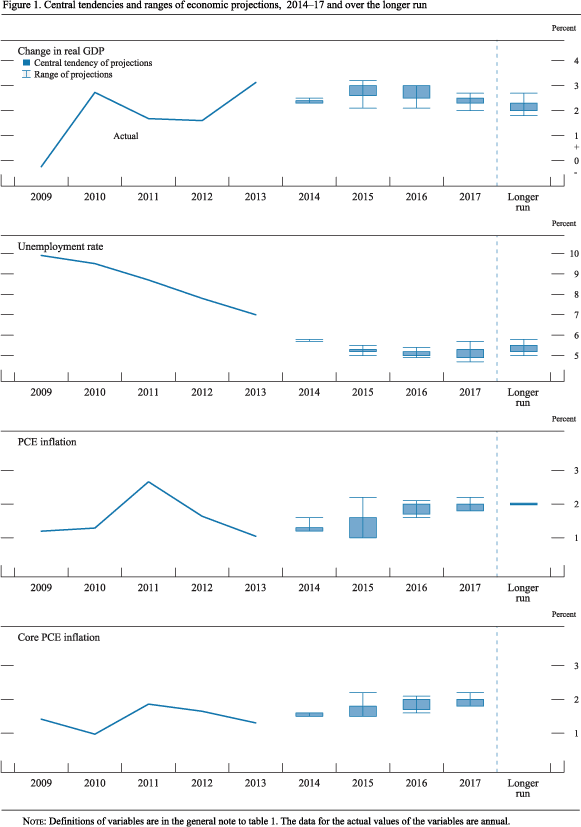
From a reading of Fed's latest Monetary Policy Report, it would appear that Fed may  begin raising the target range for the federal funds rate later rather than earlier in 2015 as the unemployment rate would be at or below 5.5 % at the end of the year. Inflation is largely expected to be at or below the Committee's 2 percent goal at the end of that year. (Underlining by us to emphasize the majority Fed View)


Economic Projections of Federal Reserve Board Members and Federal Reserve Bank Presidents Dec. 2014

Variable                                                               2014             2015            2016                       2017

Change in real GDP
2.3 to 2.4
2.6 to 3.0
2.5 to 3.0
2.3 to 2.5


Unemployment rate
5.8
5.2 to 5.3
5.0 to 5.2
4.9 to 5.3
PCE inflation
1.2 to 1.3
1.0 to 1.6
1.7 to 2.0
1.8 to 2.0

Source: Federal Monetary Policy Report Feb. 24 2015 


Without any risk or responsibility.  

Tuesday, February 24, 2015

Dollar talked down by Yellen

As predicted here, dollar weakened after the Yellen testimony.
With no risk or responsibility. 

Yellen's Testimony on Fed Monetary Policy Key quotes

" basis of incoming data, the Committee is reasonably confident that inflation will move back over the medium term toward our 2 percent objective...

It is possible, for example, that it may be necessary for the federal funds rate to run temporarily below its normal longer-run level because the residual effects of the financial crisis may continue to weigh on economic activity. ..." 


Without any risk r responsibilty

Yellen's Testimony Quotes

"Foreign economic developments, however, could pose risks to the outlook for U.S. economic growth. Although the pace of growth abroad appears to have stepped up slightly in the second half of last year, foreign economies are confronting a number of challenges that could restrain economic activity. In China, economic growth could slow more than anticipated as policymakers address financial vulnerabilities and manage the desired transition to less reliance on exports and investment as sources of growth. In the euro area, recovery remains slow, and inflation has fallen to very low levels; although highly accommodative monetary policy should help boost economic growth and inflation there, downside risks to economic activity in the region remain. The uncertainty surrounding the foreign outlook, however, does not exclusively reflect downside risks. We could see economic activity respond to the policy stimulus now being provided by foreign central banks more strongly than we currently anticipate, and the recent decline in world oil prices could boost overall global economic growth more than we expect.
U.S. inflation continues to run below the Committee's 2 percent objective. In large part, the recent softness in the all-items measure of inflation for personal consumption expenditures (PCE) reflects the drop in oil prices. Indeed, the PCE price index edged down during the fourth quarter of last year and looks to be on track to register a more significant decline this quarter because of falling consumer energy prices. But core PCE inflation has also slowed since last summer, in part reflecting declines in the prices of many imported items and perhaps also some pass-through of lower energy costs into core consumer prices."

Without any risk and responsibility 

Yellen's thinking might be restrained by European deflation fears...

As the Federal Reserve Chairwoman Janet Yellen  speaks to the Congressional Committees in a little while from now  today and then tomorrow, she may have less worries in her mind on the US economy and growth rate but  more on the European woes. Europe looks like flattering Japan through imitation of its long, winding recession. The gloating Germans who have drubbed the Greeks may not have solved the European problem any better.  If there was a worry earlier of a massive flight of capital away from the emerging markets, it now looks like that those fears have been substituted by concerns on a faltering Europe which needs structural reforms and which is lost in its myriad directives and institutions. So the Fed may hold back ; soften the US monetary policy.

The Fed  may like to  but may still be patient.

For the US industry, a depreciated dollar helps compete better.
Buy on the rumor, sell on the fact!

Without any risk or responsibility

Friday, February 6, 2015

Will the Fed be tempted to hike?

Given the momentum of the US economy, the Fed may be tempted  to move in. However, the Fed may delay intervention as at this moment, the global growth looks vulnerable to recessionary trends.

Any increase in rates might result in a flight of capital from emerging economies into USA. Interest hikes might upset the balance of competitiveness adverse to USA companies.


Views expressed without any risk or responsibility.