Showing posts with label Fed Rate. Show all posts

Sunday, November 8, 2015

India: Reverting to a new Hindu rate of growth?

India a Divided polity  and a fragmented society. Sub optimal India held back by lack of consensus

1. Politics and society may well hold Indian growth back. The provincial  election results seem to  put the clock back on India's yearning for reforms. An emboldened opposition will  now be more aggressive, which could well imply obstructing reforms. The upper house numbers will just not add up to lend support to crucial legislative  reforms. It will be an era of concessions and compromises. Restrictive practices are bound to be nurtured by re-energized trade unions. The political setback to the Government will fuel disquiet. India's bank unions have disregarded  high levels of NPA and lower productivity in many of the state run banks and are calling for a nation wide strike against reforms. . Disinvestment plans will be rolled back. India will revert to  being inside the production possibility curve. Populist measures will return in a country which has a 3.9 % fiscal deficit. Already low on investor confidence as evidenced by large volume withdrawals by FIIs, the uncertainty will shake up Mumbai stock exchange with local investors naturally seeking to exit. Domestic financial institutions may be prompted to support  rather than natural demand and supply arriving at a new equilibrium. The burden is then passed on to the taxpayer.  

Is India reverting to a sub optimal improvised (doubled?) Hindu rate of growth? (This term was coined by  an Indian Professor, Raj Krisha who spoke of the 1950-80 average of 3.5 % growth) . India seems incapable of a double digit growth.  China is already at least nearly a decade ahead and India just cannot seem to catch up. Less talk and more consensus driven work may well be a good advice for less government and more effective governance.

===
2. San Francisco Federal Reserve Bank President John Williams  thinks it makes sense to gradually remove the policy of accommodation that helped get the  economy. One more move on the chessboard towards an interest rate hike. That should put emerging markets under pressure. Fed seems to move one step in the direction of hike.

Views expressed are without any risk or responsibility. This blog recommends no investment.


Tuesday, October 6, 2015

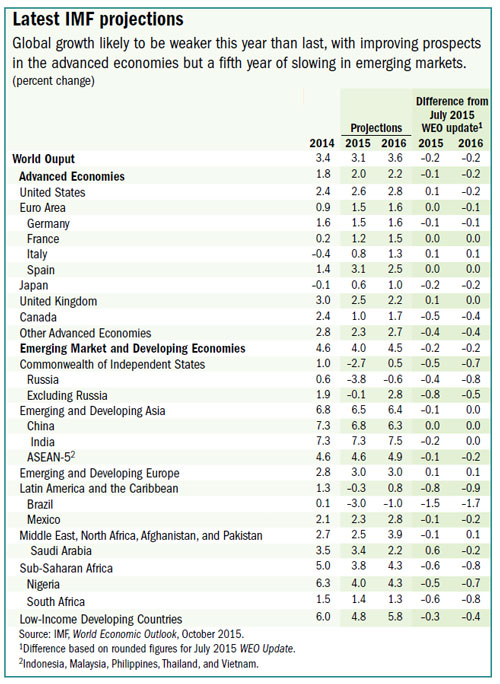
IMF's World Economic Outlook cautions amidst a slowing world economy

We Quote:

  • Global growth moderate and uneven, forecast at 3.1 percent this year, 3.6 percent in 2016
  • Disparate fortunes between the advanced and emerging market and developing economies
  • Lower commodity prices weigh on commodity exporters
  • China’s economic transformation—away from export- and investment-led growth and manufacturing, in favor of a greater focus on consumption and services; 
  • The fall in commodity prices;  
  • the impending increase in U.S. interest rates, which can have global repercussions and add to current uncertainties.
  • Disruptive asset price shifts and a further increase in financial market volatility could involve a reversal of capital flows in emerging market economies. Further, renewed concerns about China’s growth potential, Greece’s future in the euro area, the impact of sharply lower oil prices, and contagion effects could be sparks for market volatility.
    • A further appreciation of the U.S. dollar could pose balance sheet and funding risks for dollar debtors, especially in some emerging market economies, where foreign–currency corporate debt has increased substantially over the past few years.
    • Increased geopolitical tensions in Ukraine, the Middle East, or parts of Africa could take a toll on confidence.
Unquote (October 6, 2015)
 

Monday, September 21, 2015

The Fed Reserve has to move rates up shortly...

The Fed has been kind to emerging markets and Europe in some measure,  It refrained from  adding to instability in the financial world when it restrained from any move up in the rate. First Greece (read Europe) and now China is  adding to the pressures on the Fed.

Te Fed,  unlike the IMF or the BIS is not a multinational institution. US economy remains and will remain at the heart of its concerns. The evidence that it is seeking to pick up on the pick up of the US economy is surely there- may be though in driblets. As the  data  of a resurgent US economy  is conclusive, the Fed has to but take note.   Therefore, it cannot but move up the rates.

Federal Reserve Bank of Dallas'  Globalization and Monetary Policy Institute, in its

Working Paper No. 34 (by William White) points out that 
'monetary policies designed solely to deal with short term problems of insufficient demand could make medium term problems worse by encouraging a build up of debt that cannot be sustained over time. The conclusion reached is that monetary policy should be more focused on “preemptive tightening” to moderate credit bubbles than on “preemptive easing” to deal with the after effects. There is a need for a new macrofinancial stability framework that would use both regulatory and monetary instruments to resist credit bubbles and thus promote sustainable economic growth over time." 

The Fed cannot ignore national interests. It will have to indulge in preemptive tightening. 

The views expressed are purely academic without any risk or responsibility. This blog recommends no investment. 

Thursday, July 23, 2015

Jobless Data: US on course for rate hike...?

" In the week ending July 18, the advance figure for seasonally adjusted initial claims was 255,000, a decrease of 26,000 from the previous week's unrevised level of 281,000. This is the lowest level for initial claims since November 24, 1973 when it was 233,000. The 4-week moving average was 278,500, a decrease of 4,000 from the previous week's unrevised average of 282,500. "


Source of Extract:U.S. Department of Labor Employment and Training Administration Washington, D.C. 20210 Release Number: USDL 15-1450-NAT


Note: This blog offers no investment advice. The views expressed here are without any risk or responsibility


Monday, July 20, 2015

The return of Gold as an investment avenue might synchronize with the Fed hike...

If the Fed expects
full employment and
it senses growth on track, and
it sees a likely raise of the inflation head and
it increases the interest rates,
then gold investors might see stability.
As the higher the expected price rise, the better gold as a hedge.
In emerging economies, interest rates have to move up  to attract investment and there could be money price  induced real inflation. 
Gold then becomes a stabilizer.


Note: This blog offers no investment advice. The views expressed here are without any risk or responsibility. 

The Fed message : "To be forewarned is to be forearmed"

St. Louis Fed President J Bullard told Fox Business Network that there was a better than 50 percent chance that the U.S. central bank will raise interest rates in September.That had the dollar strengthen. That had the market hasten up expectations of a rate hike. That also  keeps the anticipations of a British hike ticking. 

If the dollar strengthens against the yen, then Nikkei should fall. So also other Asian stock markets in tandem. Buying oil becomes a shade costlier for all. For the GCC countries selling oil became a little more difficult as it has become expensive, given that oil is invoiced in dollars.

With the calm banks in Greece, the euro must be looking for a breather and a climb. If the euro climbs, the exports from Europe may hold back a stock market runaway.

Chinese authorities continue their macho state vigil and intervention in markets. The more you liberalize, the more you control. 

Indian politicians , as usual,  are  determined to talk loose and work less. So reforms are stalled and FIIs may well do to exit. Its banks NPA remains a cause for worry. 


This blog offers no investment advice. Views expressed are without any  risk or responsibility

Friday, May 15, 2015

Fed believes that emerging economies can cope with the rate rise ...

From: Panel remarks by Mr William C Dudley, President and Chief Executive Officer of the Federal Reserve Bank of New York, at the Sixth High Level Conference on the International Monetary System: Monetary Policy Challenges in a Changing World, Zurich, Switzerland, 12 May 2015.


Federal  Reserve believes that that many Emerging Market Economies (EMEs) generally seem better equipped to respond to the Fed's prospective exit from its exceptional policy accommodation than they were during past tightening cycles.  

" Among the positives are:
  • The absence of pegged exchange rate regimes that often came undone violently during periods of acute stress;
  • Improved debt service ratios and generally moderate external debt levels;
  • Larger foreign exchange reserve cushions;
  • Clearer and more coherent monetary policy frameworks, supporting what are now generally low to moderate inflation rates;
  • Generally improved fiscal discipline; and
  • Better capitalized banking systems, supported by strengthened regulatory and supervisory frameworks."


The Fed is obviously building grounds for a rate hike. as and when that happens. 

Views expressed without risk or responsibility